
ADHD Doom Piles: Sort One Pile Without Spreading It Everywhere
Sort an ADHD doom pile without spreading the mess. Use a small sorting area, clear destinations, and a review plan for papers and undecided items.
 AuthorVitaly Chopik
·7 min read

In brief
What to take away
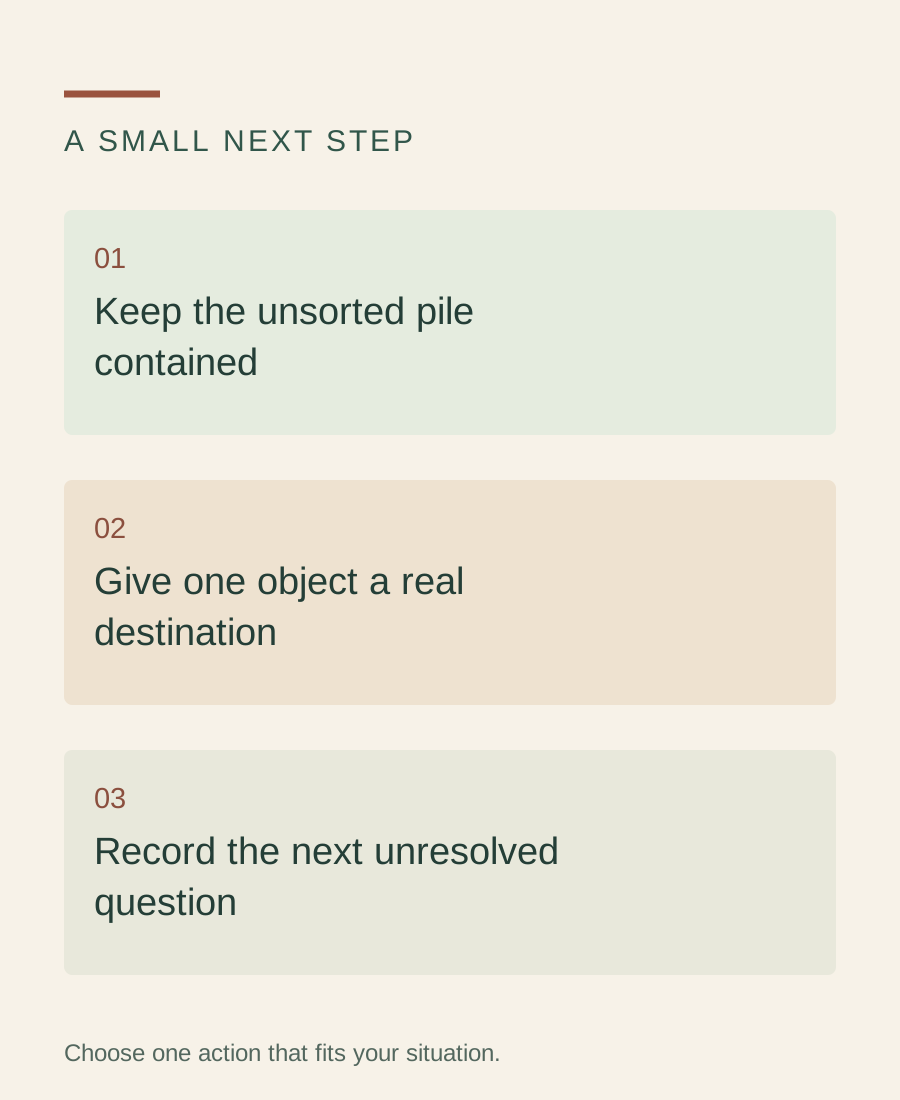
- Keep the unsorted pile contained.
- Give one object a real destination.
- Record the next unresolved question.
Sort one pile, not the entire house
To work through an ADHD doom pile, give yourself a small sorting area, a limited number of destinations, and a way to close the session. Take one object at a time from the pile. Keep the rest contained. Do not empty every box onto the floor to make the task feel official.
“Doom pile” is informal language for a collection of things that have accumulated without a useful organizing system. It is not a medical term, and a pile cannot establish whether someone has ADHD. The useful question is what decisions the pile contains and which of them need action now.
This guide is for a bounded pile of ordinary belongings and papers. If there are hazards, infestation, or severe difficulty discarding possessions that compromises living spaces, practical help and appropriate professional support may be needed.
Why mixed piles are unusually demanding
A single pile might contain a receipt, a battery, an appointment letter, a broken clasp, and a photograph. Each requires a different type of decision. Switching between them can be more demanding than processing a group of similar items.
There may also be uncertainty about consequences. Is the receipt needed for a return? Does the letter contain a deadline? Can the battery go into ordinary waste? Delaying those decisions may have been understandable when you first set the objects down.
Organizational supports can reduce the amount you need to hold mentally. For a wider explanation of that demand, see ADHD and working memory. The method here is a practical adaptation, not a clinically tested treatment.
Prepare four destinations and one work area
Use a clear section of table or a tray. Leave most of the pile in its original container. Choose destinations that match what is actually in it:
- Return to a known home. You know where it belongs and can place it there.
- Action required. A specific person, deadline, or task is attached.
- Leave the home. Ordinary waste, appropriate recycling, donations, or items to return to someone else.
- Decide after checking. The missing information is named.
These do not need to be matching storage boxes. A sheet of paper under each group may be enough. Keep batteries, medicines, confidential documents, and other items requiring special disposal separate; follow local disposal guidance rather than guessing.
Limit the checking group. If it becomes as large as the original pile, reduce the number of objects you open in this session and identify what information would actually resolve the uncertainty.
A one-object decision path
Pick up one item and ask: does this contain a safety issue or a time-sensitive obligation? If so, give it a visible action destination. Do not bury a medical appointment or payment deadline under a new “important papers” stack.
If there is no urgency, ask whether you use it and know its home. Return it there or put it in a small delivery basket for one trip after sorting. If it belongs to another person, ask before discarding it.
If you want to keep it but cannot identify storage, pause before buying another container. Decide what category the object belongs to and whether there is room for that category. A box can contain objects without solving the decision about keeping them.
If information is missing, write the question: “Does this charger fit the old camera?” A concrete question is easier to answer than “sort cables.” When you have answered it, the item should leave the checking group.
Process papers without creating a second paper pile
| Paper | What to check | A useful destination |
|---|---|---|
| Appointment letter | Date, location, preparation instructions | Calendar entry plus a place for required documents |
| Bill or account notice | Due date, amount, whether already handled | Named admin action with a deadline |
| Receipt | Return, reimbursement, or record requirement | Relevant folder or secure disposal when no longer needed |
| Personal correspondence | Whether you want to reply or preserve it | Reply list or a bounded keepsake location |
| Unknown official document | Sender and purpose | A specific question for the relevant organization |
Do not use this table as document-retention advice. Requirements vary by document and location. If unsure about a legal, tax, immigration, insurance, or medical record, check the relevant authority before disposing of it. Protect personal information when discarding papers.
Close the session while the pile is smaller
Before stopping, take delivery items to their known homes if feasible. Put outgoing items where they can leave without blocking a route. Transfer deadlines to the system you actually check. Do not depend on remembering why an object looked important today.
Label the remaining container with the next action and a realistic review slot. For example: “Check camera charger; open two account letters.” Avoid a deadline chosen only to make the label look productive.
If you have no energy for all the closing steps, stop sorting sooner next time. Closure is part of the task, not an optional extra after the “real” work. A smaller session that includes putting things away is often more sustainable than a large session that leaves new piles everywhere.
Prevent the same pile from rebuilding
Look at the recurring items. Papers near the front door may need an action tray there. Objects waiting to go upstairs may need a small delivery basket and an existing cue for carrying it. Chargers may need an accessible storage location near where they are used.
Give incoming objects a limit and an owner. In a shared household, a tray should not silently become one person’s responsibility for everyone else’s belongings. Agree what belongs there and when each person checks their items.
If objects repeatedly disappear into opaque boxes, use a visible label or a shallower container. If everything stays visible and becomes overwhelming, reduce the number of active items. Our executive dysfunction guide explains why external systems can help without eliminating every decision.
Download the action sheet
Frequently asked questions
Does a doom pile mean I have a hoarding disorder?
No. A mixed pile alone does not establish any diagnosis. Persistent difficulty discarding possessions, distress, and loss of usable living space deserve a more specific assessment. Ask for support if safety, access, hygiene, or relationships are being seriously affected.
Is it okay to put uncertain items in a temporary box?
Yes, if the box has a size limit, a named question, and a realistic review plan. It becomes less useful when objects disappear into it indefinitely. Keep urgent papers and essential items out of a general uncertainty box.
Should a friend sort the pile for me?
They can help if you want that. Agree whether they will hold the categories, read deadlines aloud, carry items, or simply keep you company. You should retain control over private papers, keepsakes, and disposal decisions. See our body-doubling guide for setting expectations.
What if I only process five objects?
Five objects with real destinations can be useful progress. Notice whether the pile is smaller and whether an urgent item was handled. The next session can start from the remaining container without reconstructing the entire plan.
Evidence base
Sources
Continue reading

What Is Executive Dysfunction? An Everyday Guide
Executive dysfunction means difficulty using mental skills that help you plan, start, switch, remember, and finish. See concrete examples and ways to reduce friction.
· 6 min read
An ADHD laundry system for clothes that never get put away
A simple ADHD laundry system for clean clothes that stay in baskets. Plan washing, drying and storage around the step that actually stalls.
· 6 min read
ADHD Paralysis: What Feeling Stuck Can Mean
ADHD paralysis is an informal name for feeling stuck despite wanting to act. Sort choice, start, transition, and overwhelm barriers to find a useful next move.
· 5 min read