
ADHD Dopamine Menu: Make One That Fits Your Time, Energy, and Budget
Make an ADHD dopamine menu with low-cost activities, realistic time limits, and easy stopping points, without misleading claims about brain chemistry.
 AuthorVitaly Chopik
·7 min read

In brief
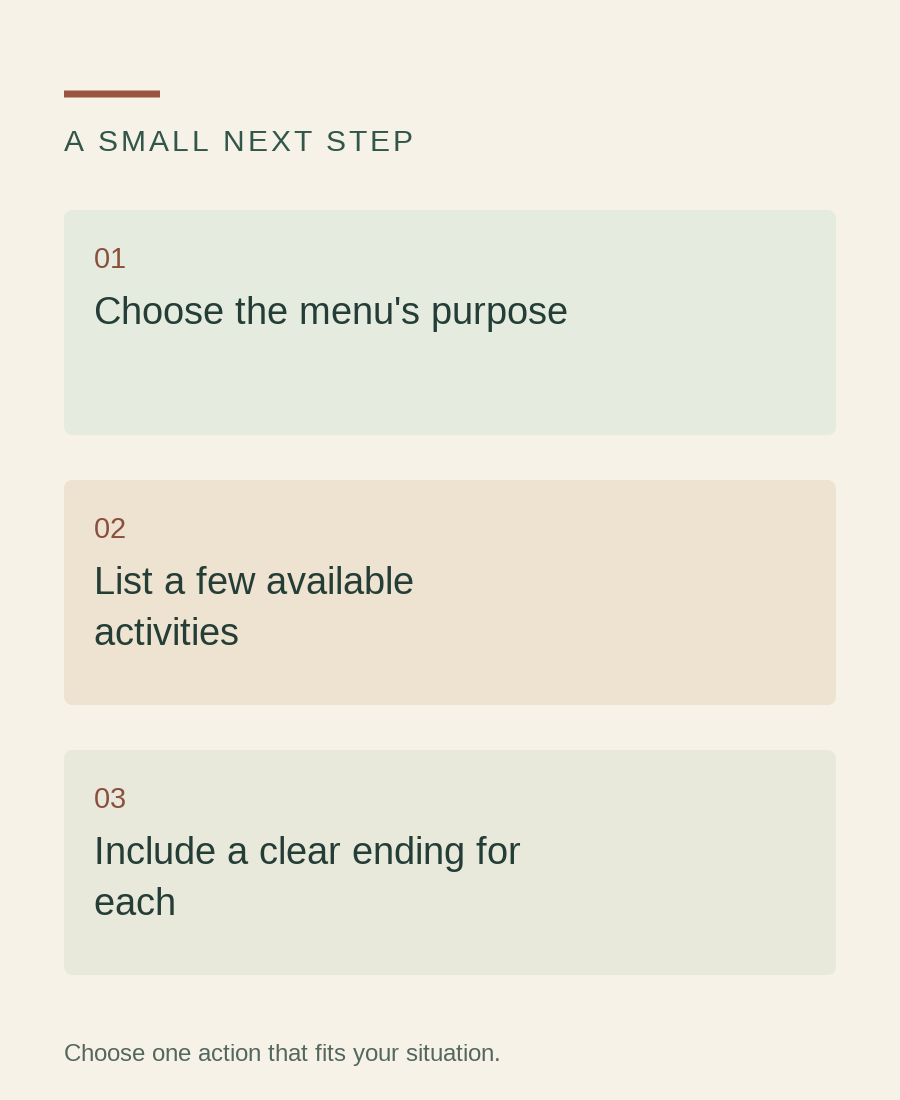
What to take away
- Choose the menu's purpose.
- List a few available activities.
- Include a clear ending for each.
Treat a dopamine menu as an activity list
An ADHD dopamine menu is a popular name for a short list of activities you find enjoyable, engaging, comforting, or refreshing. You can organize the list by available time, energy, cost, and how easy the activity is to stop.
The name is a metaphor. A menu does not measure dopamine, diagnose a deficiency, or provide a proven way to “reset” brain chemistry. Dopamine has complex roles in the brain; feeling bored or depleted does not tell you its level.
Used without those claims, an activity menu can solve a practical problem: deciding what to do when you want a break but cannot think of an appealing option. The suggestions below are organizational experiments, not a replacement for ADHD assessment or treatment.
Decide what you want the menu to help with
Choose one purpose first. You might want a short break between tasks, a low-cost way to enjoy the evening, a quieter alternative to scrolling, or an activity that helps you reconnect with something you like.
Different purposes need different options. A complex craft project may be enjoyable but unsuitable when you need to return to a call shortly. A brief walk may fit one person’s needs and be inaccessible or unsafe for another.
Enjoyment does not have to earn its place through productivity. The menu can include activities you value simply because they are pleasant.
Build a small menu with practical labels
Start with a few activities you already like. Avoid filling the page with aspirational hobbies you do not currently have the supplies, space, or energy to use.
| Available capacity | Possible activity | Setup | Ending cue |
|---|---|---|---|
| Brief pause | Listen to a chosen song | Headphones if useful | The song ends |
| Quiet, low energy | Sit by a window with a familiar drink | An accessible seat | Return at the agreed time |
| Some movement | A short accessible route or gentle activity suited to you | Suitable clothing or equipment | Return to the starting point |
| Creative time | Use a small set of art or craft materials | Materials already available | Finish one bounded part |
| Social connection | Send a friend a brief message | Contact details | Send, then leave space for a reply |
These are examples, not medical exercise, sensory, or dietary advice. Replace any option that does not fit your body, environment, or preferences.
Include time, money, and stopping cost
An activity may be easy to start but hard to leave. A video platform, shopping site, game, or absorbing project can continue well beyond the intended break. That does not make the activity inherently bad; it means the stopping plan matters.
Give the activity a boundary you can notice: one level, one episode selected in advance, a particular page, or a clear return time. If that boundary repeatedly fails, use the activity when you have more open time or choose another option for short breaks.
Include no-cost and low-setup choices. A menu that requires buying supplies or traveling somewhere every time may not help when decisions and money are already limited. Do not make browsing for the perfect menu item another route into unwanted spending.
Keep enjoyable activities separate from basic needs
If you are hungry, exhausted, in pain, or overdue for necessary care, an entertainment choice may not address the immediate need. Pause to ask what would make you more comfortable and safe before treating the problem as boredom.
Do not use access to meals, rest, medication, or essential care as a reward you must earn by completing work. You can pair a difficult task with something pleasant, but basic needs should remain available.
The menu is also not a substitute for changing an excessive workload. If every break is spent trying to recover enough to tolerate the next demand, look at the larger pattern and consider support.
Try the menu in one real situation
Suppose you have a gap between two tasks and usually open a feed without deciding when to stop. Put three alternatives beside the place you work: a selected song, a brief stretch suited to you, or sitting with a drink away from the screen.
Choose according to the time available. When the break ends, leave a visible first action for returning to work. If you want more open-ended leisure later, schedule it where possible rather than trying to squeeze it into a narrow transition.
Notice the result without forcing a success story. Did the activity feel enjoyable? Did it fit the available time? Was returning manageable? A choice can be pleasant and still be unsuitable for that particular gap.
Review the list instead of expanding it endlessly
Remove options you never choose, dislike afterward, cannot access, or repeatedly use in ways that conflict with your priorities. Keep the list short enough to scan. A menu of five real choices may be more useful than a collection of fifty ideas.
If you are struggling with task entry, our task initiation guide addresses a different problem. For transitions, see adult ADHD task switching. If company helps, body doubling is another optional support.
Persistent loss of pleasure, marked fatigue, or difficulty functioning deserves professional attention. Do not interpret those changes as proof that your menu needs more stimulating options.
Download the action sheet
Frequently asked questions
Does a dopamine menu increase dopamine?
The popular name does not establish a measurable effect for your menu or your brain. Treat it as a practical list of activities. It is not a validated test, treatment, or method for correcting a presumed chemical deficiency.
Should I avoid screens completely?
Not necessarily. Consider the activity’s purpose, enjoyment, and stopping cost. Some screen activities fit a short break; others are better suited to open leisure time. Choose based on what happens in your life rather than a universal “good” or “bad” category.
Can I use it as a reward system?
You can connect an enjoyable activity to a task if that helps, but do not make basic needs conditional on performance. If the reward repeatedly becomes difficult to stop or the task remains unmanageable, adjust the arrangement.
How many activities should I include?
Start with a small number that cover different levels of time and energy. Add an option only when it solves a real gap. The menu should reduce deciding, not become another collection you feel responsible for maintaining.
Evidence base
Sources
Continue reading

Why Starting a Task Can Feel So Hard
Task initiation is the move from intention to action. Use a worked worksheet to locate the hidden decisions in a task and make your first move clearer.
· 7 min read
ADHD Task Switching in Adults: Why Transitions Can Feel So Hard
Switching tasks with ADHD can involve attention, working memory, time, and emotion—not a lack of care. Learn how to make transitions less costly.
· 5 min read
ADHD Body Doubling: What It Is, Why It May Help, and Its Limits
Body doubling means doing a task while another person is present. Some adults with ADHD find it useful, but evidence and individual responses vary.
· 7 min read