
ADHD Masking: Everyday Examples and the Effort Behind Them
Explore everyday examples of ADHD masking, the difference between support and concealment, and ways to reduce effort without giving up your privacy.
 AuthorVitaly Chopik
·6 min read

In brief
What to take away
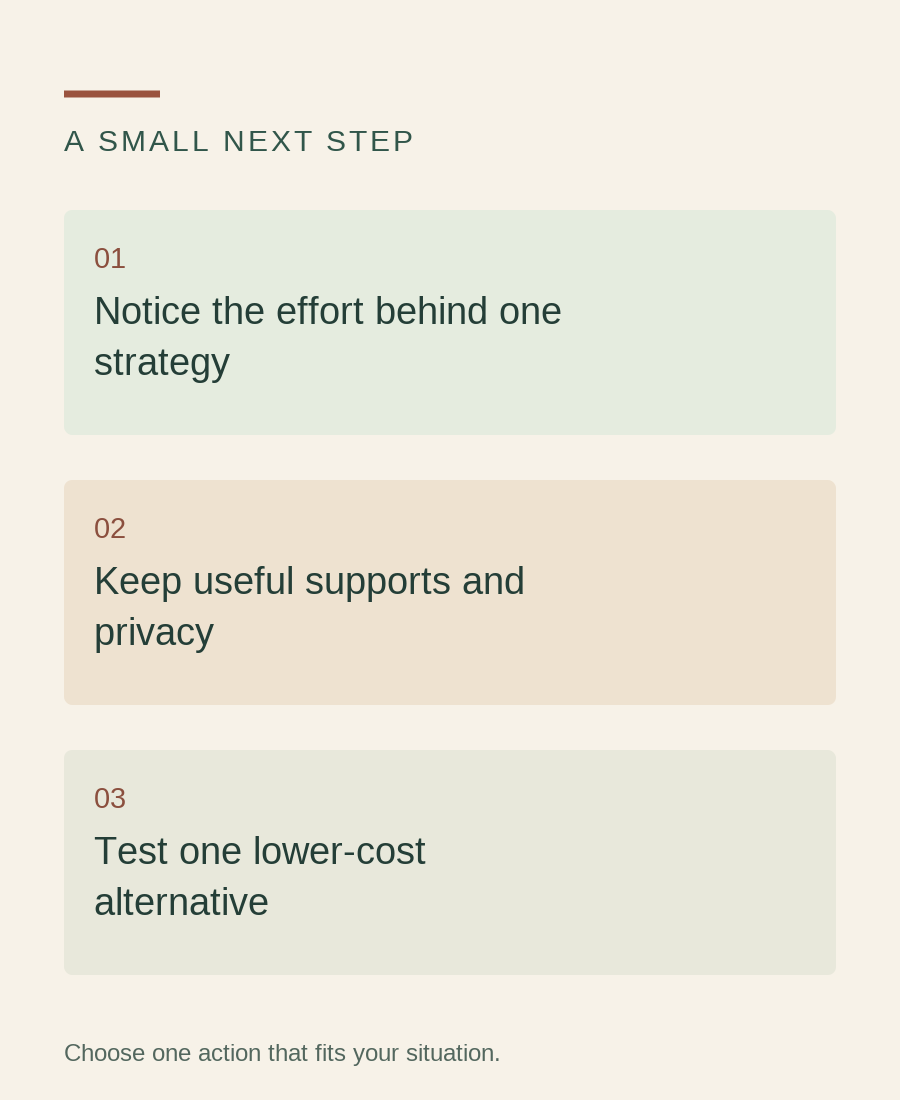
- Notice the effort behind one strategy.
- Keep useful supports and privacy.
- Test one lower-cost alternative.
What ADHD masking can look like
ADHD masking is an informal way to describe hiding, suppressing, or compensating for difficulties so they are less visible to other people. Examples can include pretending to follow a conversation after losing the thread, concealing the effort required to stay organized, or suppressing movement because it attracts criticism.
The term can help explain hidden effort, but it is not a diagnostic test. Everyone manages what they show in different settings, and not every coping strategy is masking or harmful. The useful question is whether a strategy helps you function, protects a choice you value, or consumes substantial effort mainly to conceal a need.
This guide explores that distinction and offers ways to reduce unnecessary cost without assuming you should disclose a diagnosis or stop using supports.
The same behavior can have different purposes
Writing notes can be a helpful external memory support. Writing and rewriting notes late into the night to ensure nobody notices a difficulty may carry a different cost. Rehearsing a presentation can be ordinary preparation; repeatedly rehearsing every possible casual conversation may become exhausting.
Do not decide whether a behavior is healthy from appearance alone. Consider its purpose, flexibility, and effect afterward. Can you choose to use it? Does it actually help the task? What happens if you stop?
Research has begun comparing camouflaging in adults with ADHD and autism, including a 2024 study in Autism Research. The concepts and measures are still developing; findings should not be turned into a universal masking checklist.
Everyday examples with the hidden effort included
| What another person sees | Possible hidden work | A question to ask |
|---|---|---|
| You appear to follow a long conversation | Guessing context after losing the thread | Could you ask for a repeat safely? |
| Every appointment is attended | Repeated checking and substantial anxiety | Would one reliable system reduce the checking? |
| You sit still through a meeting | Effort to suppress movement | Is a discreet movement option acceptable? |
| Work is always submitted | Unseen late-night compensation | Are workload and instructions realistic? |
| You seem relaxed socially | Extensive scripting and self-monitoring | Which settings allow more flexibility? |
These are possibilities, not assumptions about anyone who behaves this way. The same outward behavior may reflect preference, anxiety, autism, professional expectations, or other circumstances.
Notice the cost before choosing a change
Choose one setting and record the extra work involved. Include preparation, monitoring during the event, and recovery afterward. Identify which part is optional, which is protective, and which is required by the task itself.
For example, you may need accurate notes for work but not need to hide that you use written instructions. Or you may be in an environment where disclosure carries real risk. The best change may be a private support rather than a public conversation.
Avoid making “unmasking” another performance standard. There is no requirement to reveal every difficulty, share personal information, move in a particular way, or behave identically in every setting.
Try a lower-cost alternative in a safer setting
Choose one small experiment where the likely consequences are manageable:
- Ask for the final action in writing after a conversation.
- Say, “I lost the last part; could you repeat the decision?”
- Use an agreed movement or note-taking option during a meeting.
- Tell a trusted person how much preparation a task currently requires.
- Remove one unnecessary checking step while keeping the steps needed for accuracy.
Plan what you will observe: comprehension, effort, anxiety, task completion, or the response from others. One difficult reaction does not mean every support is unsafe, but it is information about that environment.
Our working-memory article gives external support examples. If the issue is specifically autistic camouflaging, see autistic masking; the terms overlap in everyday discussion but should not be treated as interchangeable diagnoses.
Keep disclosure a choice
You can name a functional need without giving your entire history. “Written priorities help me work accurately” is different from explaining every symptom. Formal support processes may require documentation; check the relevant workplace, college, or service process rather than assuming one rule applies everywhere.
Consider the audience, purpose, privacy, and possible consequences. A trusted friend and an employer have different roles. You may choose to share more in one setting and less in another.
If the environment is persistently hostile, the answer may include advocacy, professional support, or a change in conditions. Individual communication skills cannot guarantee a respectful response from others.
When hidden effort deserves support
Seek help when the effort is affecting sleep, mood, relationships, work, or basic care. A clinician can consider ADHD alongside anxiety, depression, autism, trauma-related difficulties, and other explanations. Relating to masking examples does not establish which diagnosis applies.
For workplace changes, our sensory accommodation guide offers examples of describing a barrier and a practical request. Psychological support can also help with shame, uncertainty, and decisions about privacy without requiring you to remove every coping strategy.
The aim is more choice and less unnecessary effort. A useful outcome may be asking for one repeat, using one visible support, or explaining one limit to a person you trust.
Download the action sheet
Frequently asked questions
Is ADHD masking an official symptom?
It is not a separate core diagnostic criterion. It is language used to discuss concealment and compensation. Assessment still considers the broader developmental pattern, symptoms, impairment, and alternative explanations.
Is every coping strategy masking?
No. Notes, reminders, preparation, and routines can be valuable supports. Consider why you use the strategy, whether it is flexible, and what it costs. A useful tool does not become harmful simply because it makes a difficulty less visible.
Do I have to tell people about ADHD to stop masking?
No. You can make private changes, ask for practical information, or set a boundary without giving a diagnosis. Disclosure is a choice shaped by trust, purpose, and context.
Can masking happen with both ADHD and autism?
People with either or both diagnoses may describe camouflaging or compensation. Similar experiences do not prove the same underlying cause. A qualified assessment can consider both conditions when the broader history suggests that is appropriate.
Evidence base
Sources
Continue reading

What Is Autistic Masking? The Work Behind Looking ‘Fine’
Autistic masking can involve hiding, suppressing, or compensating for traits to meet social expectations. The effort may remain invisible.
· 9 min read
What Is ADHD? Symptoms, Causes, Diagnosis, and Support
A clear, detailed guide to how ADHD can affect children and adults, how it is assessed, and what kinds of support can help.
· 16 min read
Sensory Accommodations at Work: Start With the Barrier
Workplace noise, light, movement, or smells can make a job harder than the tasks themselves. Sensory adjustments work best when they target a specific barrier.
· 8 min read