
ADHD Meal Planning: A Small Rotation for Decision-Heavy Weeks
Plan meals with ADHD using a small rotation, flexible meal formats, backup options, and a weekly review that does not require a perfect menu.
 AuthorVitaly Chopik
·7 min read

In brief
What to take away
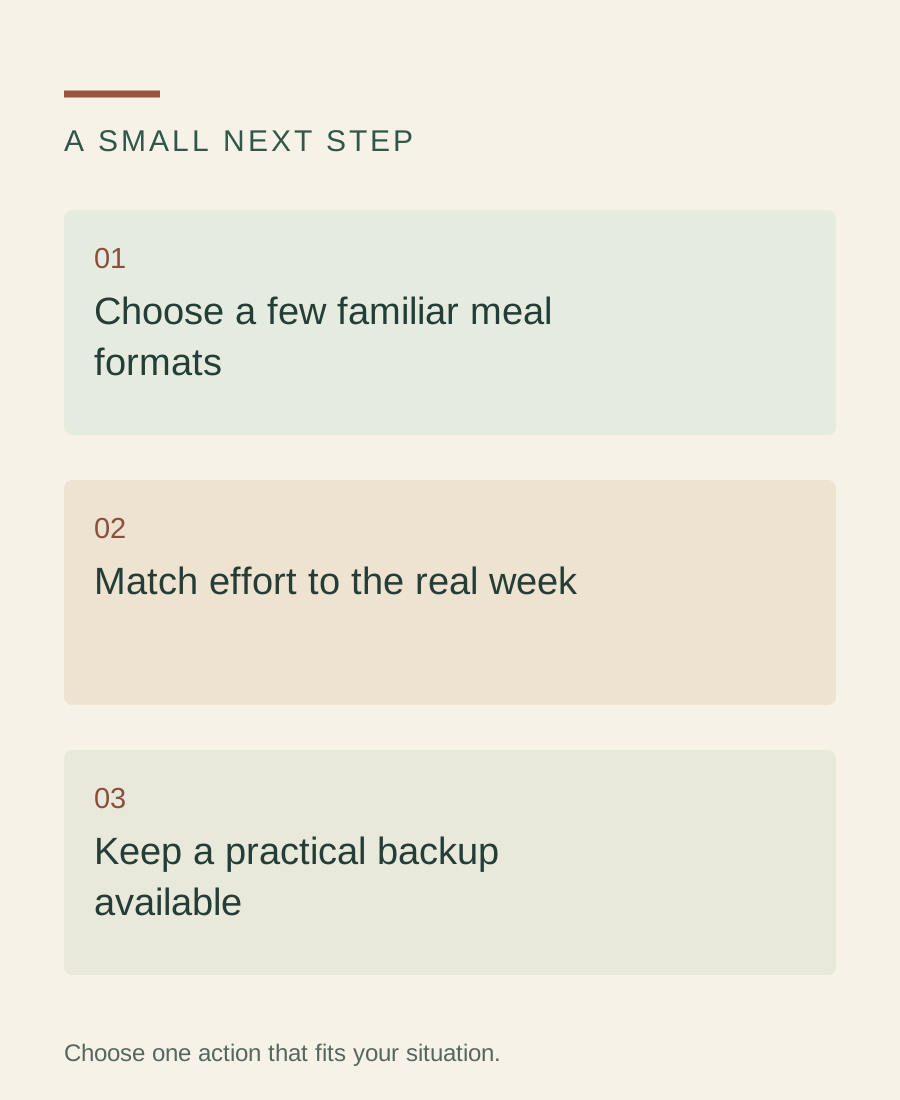
- Choose a few familiar meal formats.
- Match effort to the real week.
- Keep a practical backup available.
Plan a few meal formats, not seven perfect dinners
ADHD meal planning can start with a small rotation of meals you already eat, a few flexible ingredients, and backup food for days when cooking does not happen. Plan fewer meals than the number of meals in the week, leaving space for leftovers, changing plans, and convenient options.
This guide focuses on choosing what to eat and making the plan easy to revisit. It does not prescribe an ADHD diet, weight-loss plan, or nutritional treatment. Dietary needs, allergies, food access, sensory preferences, culture, and medical advice should shape your choices.
If eating is becoming difficult because of appetite loss, medication effects, restriction, distress, or problems accessing food, discuss that directly with an appropriate clinician, dietitian, or support service. A menu cannot resolve every barrier to eating.
Find out where the planning breaks down
Meal planning contains several separate jobs: choosing meals, checking supplies, shopping, preparing food, storing it, and remembering it is available. A beautiful menu helps little if the ingredients remain invisible in a drawer or the recipes require more time than you have.
Choose the main friction first. If deciding is exhausting, reduce the number of meal formats. If food spoils, plan smaller quantities and make storage dates visible. If shopping is the problem, connect the menu to the ADHD grocery-list guide.
The rotation below is an example of reducing decisions. It is not a nutritionally complete prescription or a treatment supported by a trial of this particular menu.
Build your small rotation
Write down several meals or formats you genuinely tolerate and can obtain. “Something healthy” is too vague. “Toast with an available topping and fruit” gives you a decision you can act on.
Include different effort levels:
- No-cook or minimal preparation: food you can assemble safely from available ingredients.
- Quick cooking: a familiar meal with few active steps.
- More preparation: something you enjoy making when you have capacity.
- Backup: shelf-stable, frozen, prepared, or purchased food that fits your needs and budget.
Use familiar formats to allow variety. A wrap, bowl, pasta dish, soup, or sandwich can change through ingredients and flavor without requiring a completely new cooking method. Repetition is optional; the aim is fewer decisions, not eating the same thing regardless of preference.
Match meals to real days
Check the week before assigning food. A late shift, appointment, long commute, or caring responsibility affects preparation capacity. Put the simpler option where the demand is higher rather than assuming motivation will arrive at dinner time.
| Type of day | Meal format | Flexible choice | Backup |
|---|---|---|---|
| Late arrival | Assemble a wrap or sandwich | Use an available tolerated filling | A suitable ready meal |
| Ordinary evening | Familiar pasta or grain dish | Change the sauce or vegetables | A freezer portion |
| More preparation time | Cook a recipe you know | Make extra components if useful | Keep the simpler option available |
| Unpredictable day | Choose from the minimum-preparation list | Decide near the meal | Food requiring little equipment |
These are examples, not dietary instructions. Adapt them for allergies, medical needs, sensory tolerances, religious practices, and food availability.
Turn the rotation into a short shopping decision
Before shopping, check what is already available and safe to use. Choose a few meals that share ingredients where that helps, but do not buy a large quantity merely because an ingredient appears in several imagined recipes.
Write the ingredients for the meals you have actually selected. Add the usual breakfast, snack, and basic household items you need. Keep an accessible backup option on the list so it is not dependent on remembering it while tired in the shop.
If you cannot predict every meal, leave room. A partial plan that you use is more valuable than a complete menu that ignores changing appetite or circumstances. You can choose the next meal from a small list without assigning it to an exact weekday.
Make available food easy to notice
Choose a place to display the current options: a short note on the fridge, a phone note, or a label on a storage container. Include what needs using soon, following reliable storage guidance. Visibility helps only if the information stays current.
The FoodSafety.gov storage chart gives specific guidance for different foods. Follow package instructions and safe storage practices; do not rely on memory, appearance, or a general “meal prep lasts a week” rule.
If several people share food, agree what is available to everyone and what is reserved for a planned meal. A menu fails quickly if the ingredients disappear without anyone knowing a replacement is needed.
Review waste and effort without turning meals into a score
At the next planning point, ask three questions: what did you eat, what was too difficult to prepare, and what remained unused? Those observations are more useful than judging whether the week was sufficiently organized.
If the same ingredient is repeatedly wasted, buy less, use another form, or remove it from the rotation. If every planned meal requires cooking you rarely have capacity for, add more assembly options. If repetition causes boredom, keep the format but change the flavor or texture you enjoy.
For the wider problem of too many choices, see decision fatigue and mental health. A meal plan should reduce that load while preserving enough choice to make eating practical and appealing.
Download the action sheet
Frequently asked questions
Do I need to plan every meal?
No. Start with the meals that most often become difficult. Planning a few dinners or keeping breakfast options available may be enough. Leave space for leftovers, changed plans, and food you choose closer to the time.
Is eating the same meal repeatedly bad?
Repetition can simplify decisions, but nutrition needs and individual circumstances vary. A small rotation can still include variety. If your intake is very limited, changing unintentionally, or causing concern, ask a qualified dietitian or clinician for individualized advice.
Can convenience food be part of an ADHD meal plan?
Yes. Convenience can make food accessible when time, energy, equipment, or executive demands are limiting. Choose options that fit your needs, budget, and any medical advice. A plan does not become invalid because some food is prepared by someone else.
What if I do not want the planned meal when the day arrives?
Use the plan as a set of options. Swap within safe storage limits or choose the backup. Notice whether the issue is boredom, appetite, sensory discomfort, or the effort required. That information can improve the next rotation without turning dinner into a test of compliance.
Evidence base
Sources
Continue reading

An ADHD grocery list for the things you only remember after getting home
Capture groceries in one place, group the list by your route and decide what to do with unavailable items before a shopping trip becomes overwhelming.
· 5 min read
What Is Executive Dysfunction? An Everyday Guide
Executive dysfunction means difficulty using mental skills that help you plan, start, switch, remember, and finish. See concrete examples and ways to reduce friction.
· 6 min readDecision Fatigue: Why Small Choices Feel Hard When You’re Overwhelmed
Decision fatigue is a useful description for choice becoming harder under sustained load, but the evidence is mixed and the term is not a diagnosis.
· 5 min read