
ADHD Perfectionism: How to Stop Revising Work That Is Already Done
Stop revising completed work with a clear definition of done, a limited review plan, and practical ways to handle uncertainty and repeated checking.
 AuthorVitaly Chopik
·7 min read

In brief
What to take away
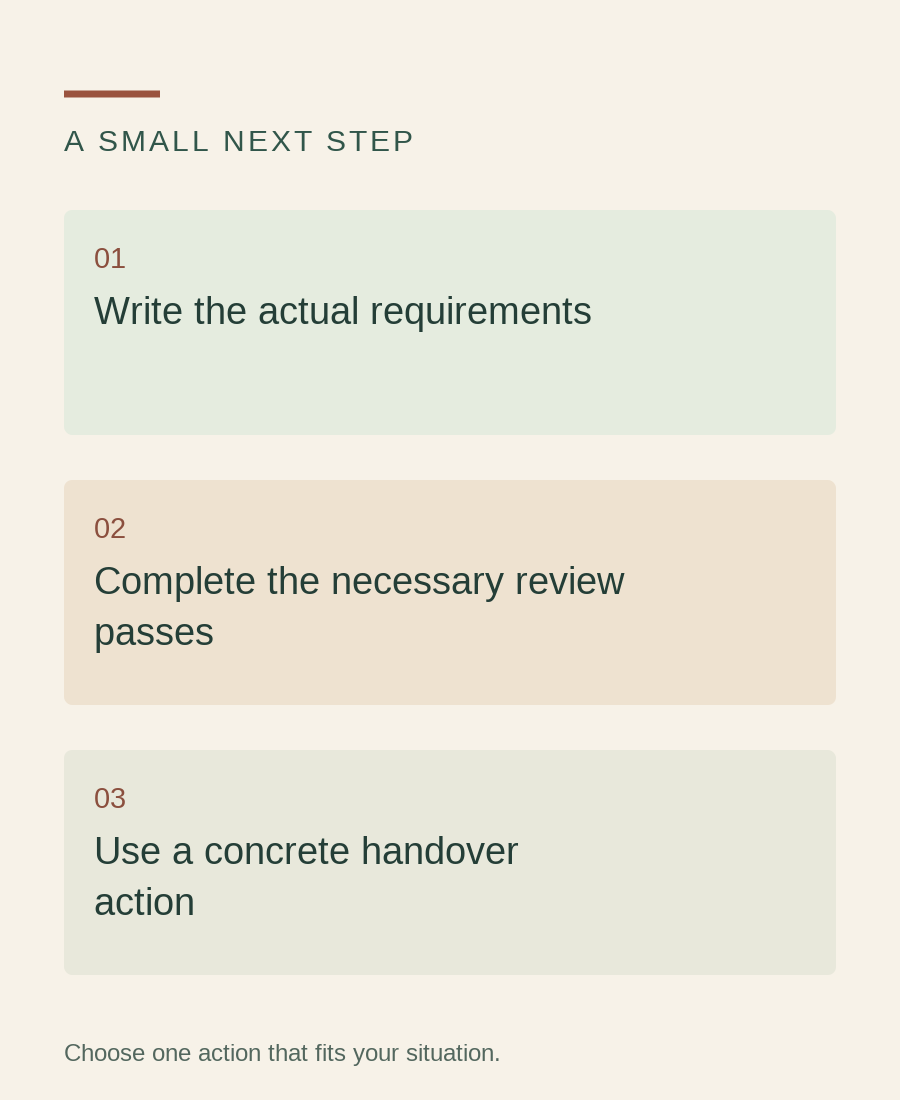
- Write the actual requirements.
- Complete the necessary review passes.
- Use a concrete handover action.
Decide what finished means before the final review
If you keep revising work that already meets the brief, define the required outcome, the checks that matter, and the point at which you will submit or hand it over. A clear stopping rule can separate useful review from repeated changes made mainly to reduce uncertainty.
ADHD and perfectionism can coexist, but perfectionism is not a core diagnostic criterion or something every person with ADHD experiences. Anxiety, past criticism, unclear expectations, high-stakes work, and other difficulties can contribute to repeated checking or revision.
This guide focuses on completing work after a draft exists. If the main difficulty is beginning, see when perfectionism keeps you from starting. Here, the question is what should happen after the work is good enough for its actual purpose.
Identify the kind of revision you are making
Some revisions fix a real error, answer a missing question, or meet an agreed requirement. Others change wording without improving the outcome, undo an earlier acceptable choice, or reopen decisions because submitting feels uncomfortable.
Ask what evidence would justify the change. “The calculation is wrong” needs correction. “I can imagine a better introduction” may or may not matter to this deliverable. “Someone could dislike it” is not a requirement you can fully satisfy.
For safety-critical, clinical, legal, engineering, or regulated work, use the required professional review process. A personal stopping rule should never replace mandatory checks or supervision.
Write a definition of done
Choose a short set of observable requirements. For a routine work email, it might be the correct recipient, the decision or request, the necessary attachment, and a clear next step. For a report, use the agreed questions, evidence, format, and deadline.
Clarify ambiguous expectations with the person who owns the brief. Repeated polishing is an expensive way to compensate for not knowing what is required. Ask which parts matter most and which refinements are optional.
| Vague standard | More useful requirement | Check |
|---|---|---|
| Make it professional | Use the agreed format and respectful language | One format and tone review |
| Cover everything | Answer the questions in the brief | Compare each required question |
| Avoid mistakes | Complete the relevant accuracy checks | Check the named facts or calculations |
| Make it impressive | Clarify the audience and purpose | Confirm what the reader needs to do |
Keep the definition visible during the final review. If you add a requirement, identify where it came from rather than silently moving the finish line.
Use separate review passes
Instead of repeatedly reading from the beginning, give each pass a purpose:
- Requirements: does the work answer the brief?
- Accuracy and safety: are the important facts, figures, names, links, and required checks correct?
- Presentation: is it readable and in the required format?
- Handover: is it going to the correct destination with the necessary context?
The number and depth of passes should reflect the stakes. A casual message does not need the process used for a published technical report. A timer can limit optional polishing, but it should not pressure you to skip necessary accuracy work.
Mark each completed pass once. If you want to repeat it, ask what new information makes repetition necessary. Rechecking without a reason can provide brief reassurance while keeping the task open.
Make the handover a concrete action
“Finish the report” is broad. “Export the agreed version, attach it to the message, check the recipient, and send” gives the final transition a sequence. Prepare that sequence before you are tired from editing.
If submitting is the difficult part, identify the feared consequence. You may need clarification, feedback, or psychological support rather than another round of wording changes. Consider asking a trusted reviewer one bounded question, such as whether the draft answers the brief.
Avoid requesting unlimited reassurance from several people. Different preferences can create more revisions without improving the work. Agree who has the authority to approve the result and which feedback is relevant.
A worked example: an email that keeps changing
Suppose you need to ask for a deadline clarification. You have rewritten the opening several times. Define the required result: the recipient understands the two possible dates and knows you need confirmation.
Check the dates, the recipient, and whether the question is clear. Remove an unnecessary explanation if it obscures the request. Then send the message. You do not need to find the one opening sentence that no reader could ever misinterpret.
Afterward, write what actually happened rather than monitoring the inbox continuously for a reaction. If a misunderstanding occurs, you can respond to the real information. That is different from editing indefinitely to prevent every imagined response.
When repeated checking needs more support
Seek help if revision and checking consume substantial time, create significant distress, prevent submission, or spread across daily life. Anxiety and obsessive-compulsive difficulties can require specific assessment; not every checking pattern should be attributed to ADHD.
Workplace changes may also help: clearer briefs, intermediate feedback, and agreed quality standards. For a broader look at the processes involved, see executive dysfunction and ADHD working memory.
The useful goal is an appropriate review process with a real ending. Completion can include ordinary uncertainty and the possibility of later feedback.
Download the action sheet
Frequently asked questions
Does a stopping rule mean accepting poor-quality work?
No. It means defining the quality needed and completing the checks that support it. The rule should reflect the stakes and any professional requirements. Optional polishing can have a limit without removing accuracy or safety checks.
What if I notice an error after submitting?
Assess the actual impact and use the appropriate correction process. A real error is something to address, not proof that you should review every future task indefinitely. Keep proportionate records of what would prevent that specific problem next time.
Should I ask someone to tell me it is good enough?
A bounded review can help when the person knows the brief. Ask a specific question and identify who can approve the result. Repeated reassurance from multiple people may keep the task open rather than resolve it.
Is this always caused by ADHD?
No. Repeated revision can relate to unclear expectations, anxiety, obsessive-compulsive symptoms, past criticism, or the stakes of the task. If it causes significant impairment or distress, seek an assessment rather than assuming one explanation.
Evidence base
Sources
Continue reading

Ask for an Accommodation Without Explaining Your Whole Life
A clear request can focus on the barrier, the change you need, and how it would help—without turning a private history into a persuasive performance.
· 6 min read
When Perfectionism Keeps You From Starting
When the first draft feels as if it must already be excellent, starting becomes risky. Separate drafting from judging and choose a useful standard for the task.
· 7 min read
ADHD Working Memory in Adults: Everyday Examples and Practical Supports
Working memory helps keep information available while you use it. ADHD can add friction, but practical external supports can reduce what the mind must hold.
· 10 min read