
Decluttering With ADHD When Everything Feels Worth Keeping
Make decluttering decisions with ADHD using practical questions, limited holding space, and a gentle plan for sentimental items and unfinished projects.
 AuthorVitaly Chopik
·7 min read

In brief
What to take away
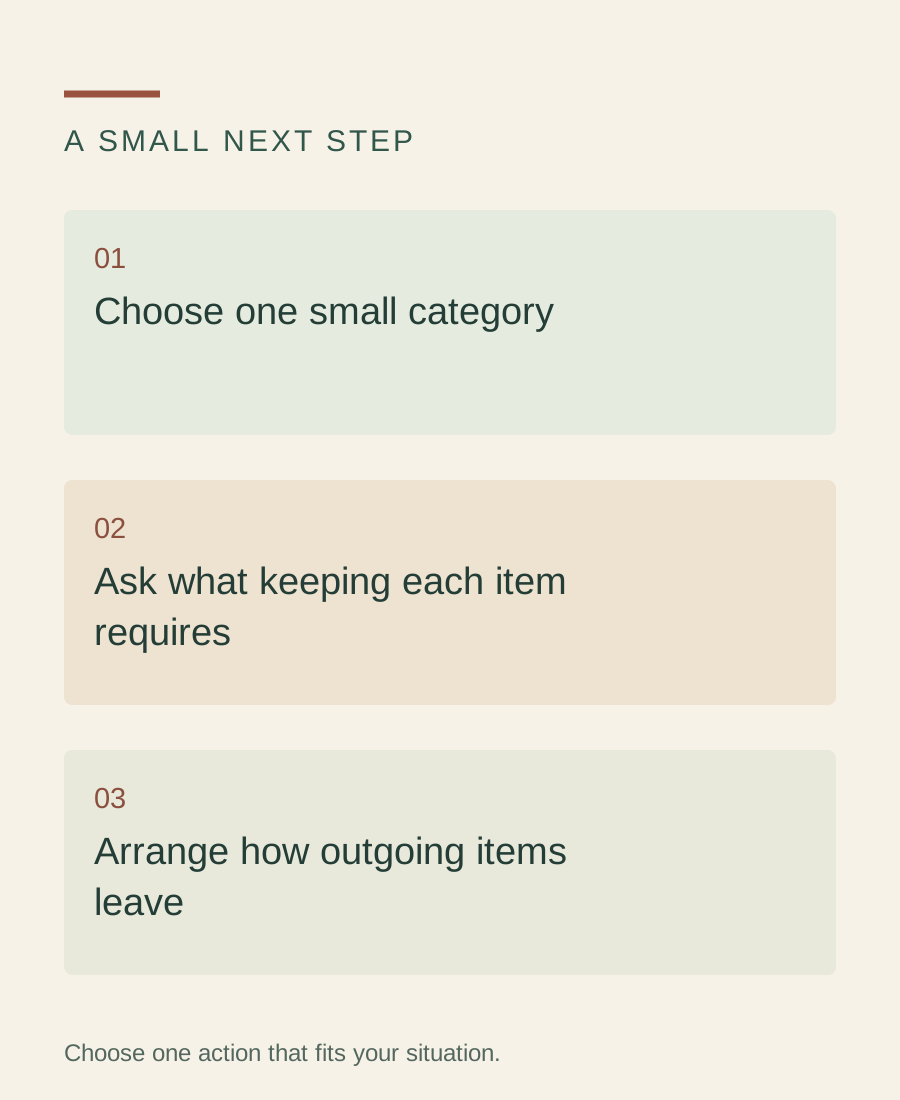
- Choose one small category.
- Ask what keeping each item requires.
- Arrange how outgoing items leave.
Make fewer decisions at one time
Decluttering with ADHD can become difficult when every object suggests a future use, an unfinished project, or a memory you do not want to lose. Start with a small category and a clear space limit. Separate decisions about usefulness, sentiment, and unfinished commitments instead of treating every possession as the same question.
You do not have to become a minimalist. The aim is to make your home support the activities and people living in it now. Keeping an object can be a reasonable decision; the question is whether the space and upkeep it requires are also choices you want to make.
The suggestions below are organizational experiments. ADHD does not explain every difficulty discarding belongings. Persistent distress, compulsive acquiring, or living areas that cannot be used safely may need professional assessment and practical support.
Identify what makes the decision hard
“I might need it” can mean several things. You may genuinely lack money to replace useful equipment. You may be unsure whether a document is legally important. Or an object may represent an activity you still hope to return to. Those situations call for different decisions.
Write the reason before deciding the destination. “Expensive to replace” invites a question about realistic use and alternatives. “I do not know what this document is” invites checking information. “This reminds me of my grandmother” belongs with sentimental decisions, not a rapid waste pass.
Be cautious with popular rules that demand an immediate answer or automatic disposal. They may not fit disability, financial constraints, cultural practices, or shared ownership. A useful boundary should reflect your circumstances.
Choose a category small enough to finish
Choose something bounded, such as one drawer of cooking utensils, a small shelf, or one bag of clothing. Keep the rest of the room closed. Place the selected items on a surface you can restore before the session ends.
Choose a practical goal: finding the utensils you use, opening the drawer easily, or seeing the clothes that currently fit. The goal helps you decide what belongs in that space. “Own less” is much less specific.
Before opening the category, prepare destinations for keeping, leaving, and checking. If an item belongs to someone else, it goes into a conversation rather than a disposal bag. Do not make a shared household agreement by throwing away another person’s possessions.
Ask questions that reflect actual use
Work through a few questions rather than an elaborate scoring system:
- What does this do in my life now? Include comfort, identity, access, and enjoyment, not only productivity.
- When did I last use it, and what would make me use it again? Seasonal and emergency items need different reasoning from everyday items.
- Is there a workable alternative I already own? Avoid keeping duplicates solely because the other one is difficult to find.
- What does keeping it require? Consider storage, cleaning, repair, attention, and accessibility.
- Where will it live? A known, usable location makes the decision concrete.
You do not need to answer all five for every object. The questions are prompts for stuck decisions. An item you use and can store comfortably may need no further analysis.
Use a space limit for uncertain belongings
A space limit can make an abstract decision visible. For example, choose one shelf for craft projects or a small box for uncertain cables. Fill the space with what matters most rather than expanding storage every time it fills.
| Reason | Possible boundary | What to review |
|---|---|---|
| Sentimental value | A keepsake box or display area | Which objects carry the memory most meaningfully |
| Future project | One active-project shelf | Whether the project still fits your interests and capacity |
| Replacement cost | Accessible storage for useful spares | Condition, actual compatibility, realistic likelihood of use |
| Missing information | One small checking tray | The exact question needed to make the decision |
A deadline can help if it is realistic, but it should not turn uncertainty into an automatic instruction to discard important documents or another person’s belongings. Review those separately.
Handle sentimental items and abandoned projects gently
Sentimental value does not have to be justified to someone else. You can choose to keep an object because it matters to you. If the collection exceeds the space you can comfortably maintain, consider selecting representative items or recording the story in another form. A photograph is an option, not a replacement you must accept.
For unfinished projects, separate interest from obligation. Would you choose this project today if you did not already own the materials? What is the smallest next action? What other commitment would need to move to make room for it?
If the project no longer fits, leaving it can release a commitment as well as space. If it still matters, give it a realistic place in your life. Keeping materials indefinitely is not the same as making time to use them.
Make leaving the home part of the plan
Donation and return bags can become new long-term storage. Before filling one, check whether the destination accepts the items, whether you can transport them, and when that trip could happen. Selling can be appropriate, but photographing, listing, messaging, and arranging collection are additional tasks.
If selling is unlikely to happen, compare the expected benefit with the time and space it costs. You can choose a lower-effort route without treating the purchase as a personal failure. Follow local rules for electronics, batteries, chemicals, medicines, and confidential records.
Finish by returning kept objects to accessible homes and writing the next review question. For mixed incoming items, our doom-pile approach can help; for clothing flow, use the laundry system. You do not need to declutter every category before improving one.
Download the action sheet
Frequently asked questions
Should I throw something away if I have not used it for a year?
That rule is optional and often too blunt. Seasonal, emergency, accessibility, sentimental, and expensive-to-replace items may still be valuable. Consider actual purpose, condition, storage, and realistic future use rather than using one date as a universal decision.
Why do I want to keep supplies for hobbies I stopped doing?
They may represent pleasure, identity, money already spent, or a hope of returning. None of those reasons is automatically wrong. Ask whether keeping the materials fits your current space and capacity, and whether the hobby still interests you today.
Can someone declutter alongside me without pressuring me?
Yes. Ask for a specific role: reading labels, carrying donations, maintaining the sorting area, or helping identify the next question. Agree that private or sentimental belongings will not be discarded without permission. Body doubling can provide company without handing over control.
When is professional help worth considering?
Consider it when discarding causes severe distress, acquiring feels difficult to control, or clutter prevents safe use of living spaces. A clinician can assess the wider pattern, while practical assistance can address immediate safety and access needs. A diagnosis should not be inferred from a single room.
Evidence base
Sources
Continue reading

What Is Executive Dysfunction? An Everyday Guide
Executive dysfunction means difficulty using mental skills that help you plan, start, switch, remember, and finish. See concrete examples and ways to reduce friction.
· 6 min read
An ADHD laundry system for clothes that never get put away
A simple ADHD laundry system for clean clothes that stay in baskets. Plan washing, drying and storage around the step that actually stalls.
· 6 min read
ADHD Paralysis: What Feeling Stuck Can Mean
ADHD paralysis is an informal name for feeling stuck despite wanting to act. Sort choice, start, transition, and overwhelm barriers to find a useful next move.
· 5 min read