
Social Exhaustion With ADHD: Planning Space Before and After Events
Plan around social exhaustion with ADHD using arrival and exit choices, recovery space, communication scripts, and a check on other sources of fatigue.
 AuthorVitaly Chopik
·7 min read

In brief
What to take away
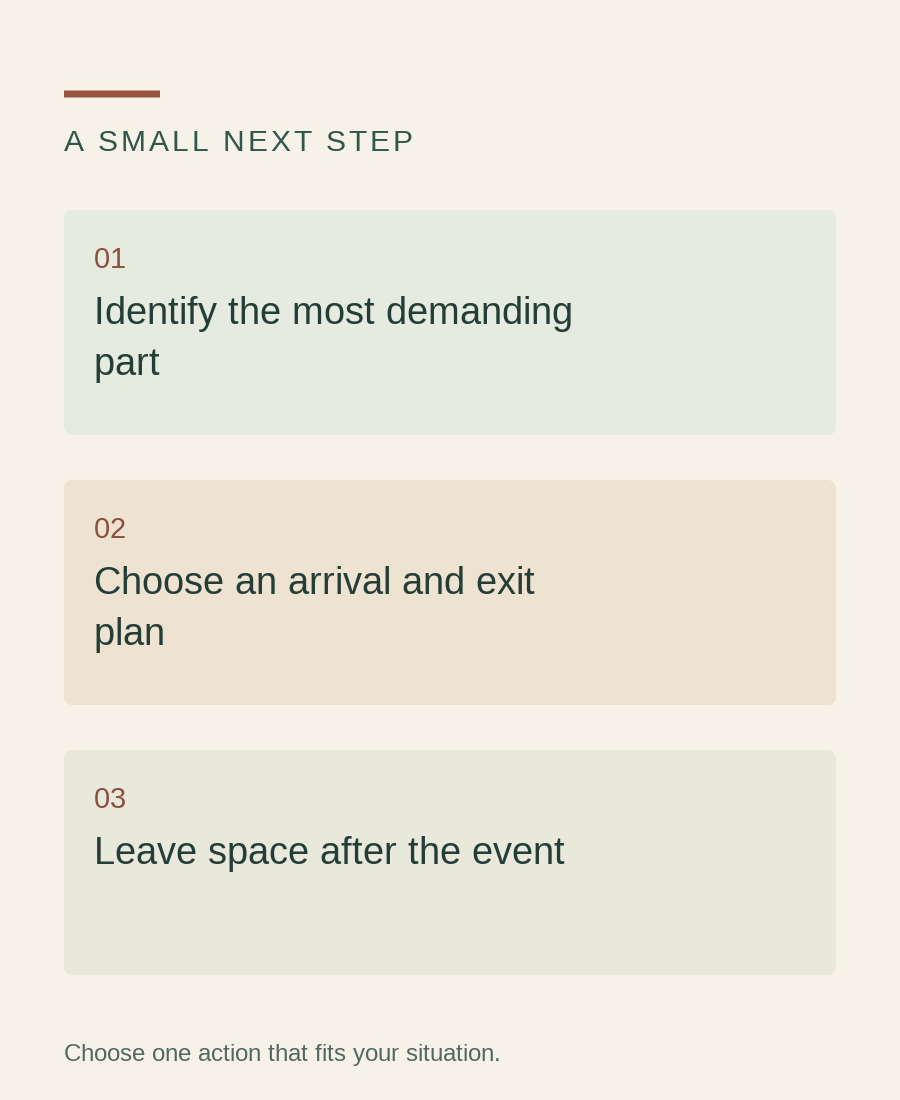
- Identify the most demanding part.
- Choose an arrival and exit plan.
- Leave space after the event.
Plan the time around the event as well as the event
If social events leave you exhausted, plan the arrival, participation, exit, and time afterward. Choose the parts that matter most and leave some flexibility around them. A shorter visit with a clear ending may be more sustainable than attending everything and needing to cancel the next day.
ADHD can make aspects of social participation effortful, including tracking conversation, managing interruptions, remembering arrangements, and resisting the urge to speak immediately. But social exhaustion is not specific to ADHD. Anxiety, sensory demands, masking, sleep loss, depression, illness, and ordinary overcommitment may also matter.
This guide helps you identify practical demands. It does not turn fatigue after an event into evidence of a diagnosis or assume that being sociable should always feel easy.
Identify the part that costs most
Think about one recent event. Was the hardest part getting ready, finding the venue, meeting unfamiliar people, following several conversations, managing noise, or deciding when to leave? “Socializing drains me” is a useful starting point, but a specific demand is easier to change.
Also note what was enjoyable. You may want the friendship or shared activity while needing different conditions. The aim is not to remove social contact by default; it is to make choices that reflect your preferences and capacity.
If noise or other sensory conditions are the main issue, our sensory hangover guide addresses that experience in more detail. Here, the focus is the whole social plan.
Before: reduce uncertainty and competing demands
Check the practical information in one place: location, travel, likely duration, who is attending, food arrangements where relevant, and how you can leave. Ask about the details that will change your decision rather than researching everything.
Choose a participation goal. It might be seeing one friend, attending the main activity, or joining the first part of a gathering. A goal makes it easier to decide when you have done what you came for.
Avoid filling every available slot before and after the event if you have a choice. Preparation and travel also use capacity. If your week is already demanding, change the social plan before you are committed to an arrangement you cannot comfortably manage.
During: make participation adjustable
Identify one acceptable way to take a break: step outside where safe, move to a quieter area, sit rather than stand, or pause conversation. You do not need to wait until distress is severe to use it.
| Difficulty | Possible adjustment | A simple phrase |
|---|---|---|
| Several conversations compete | Move to a smaller group | “Could we talk over here?” |
| You lose the thread | Ask for a brief repeat | “I missed the last part. What was the main point?” |
| The visit is running long | Use the planned exit | “I am glad I came. I need to leave now.” |
| You need a break | Step away briefly | “I am taking a quiet minute; I will check back.” |
These are optional scripts. Choose language that sounds natural to you. If explaining a diagnosis would add pressure or risk, describe the practical need instead.
After: leave a landing space
Decide what would make returning home easier: available food, a lower-demand household evening, a short message to confirm you arrived, or time without another conversation. Recovery does not need to be a complicated wellness routine.
If you repeatedly replay what you said, separate an actionable issue from uncertainty. A real misunderstanding may need one repair message. Repeatedly checking every conversation for mistakes may increase the load without producing useful information. Our rejection-sensitivity article discusses related experiences without treating them as a stand-alone diagnosis.
Notice whether the event required the amount of recovery you expected. This helps you make a better plan next time. It is not a reason to score the event as a success or failure.
An example: keeping the friendship, changing the format
Suppose a large evening gathering leaves you exhausted, but you want to stay connected with the group. You might attend the meal and leave before the later activity, meet one friend separately, or suggest a quieter shared activity on another date.
Be specific: “I would like to see you. I can join dinner, and I will head home afterward.” This gives the other person information without requiring them to infer the boundary from signs of fatigue.
The change is an experiment. A quieter event may still be tiring if travel or anticipatory anxiety is the larger demand. Use the result to identify the next adjustment rather than concluding that no social plan will work.
When social exhaustion needs a broader check
Seek advice if exhaustion is new, persistent, worsening, or limiting daily life beyond social occasions. Include physical symptoms, sleep, mood, appetite, and changes in medication or substance use. Do not assume every energy change belongs to ADHD.
If fear is steadily shrinking your social life, or you want connection but feel unable to participate, psychological support may be useful. If a relationship repeatedly ignores your boundaries, the issue may require a conversation about respect rather than a better recovery plan.
For conversation memory, see ADHD working memory. The goal is enough support to participate in ways you value, with room to choose rest and limits.
Download the action sheet
Frequently asked questions
Is social exhaustion the same as introversion?
No. People of different social preferences can become exhausted for different reasons. Look at the specific demands and the recovery pattern rather than assuming one personality label explains it.
Should I tell friends I have ADHD?
That is your choice. You can ask for a quieter place, clearer plans, or a shorter visit without sharing a diagnosis. Consider trust, privacy, and what information would actually help the arrangement.
Is leaving early rude?
A clear and considerate boundary can help others understand. Where possible, mention the likely ending in advance, thank the host or friend, and handle any shared responsibilities. You do not have to stay until you are overwhelmed to prove appreciation.
What if I still feel tired after a low-demand event?
Consider travel, sleep, health, anxiety, and the rest of the week’s demands. If fatigue is substantial or persistent, discuss it with a clinician. The amount of noise or conversation is only one part of the picture.
Evidence base
Sources
Continue reading

ADHD Working Memory in Adults: Everyday Examples and Practical Supports
Working memory helps keep information available while you use it. ADHD can add friction, but practical external supports can reduce what the mind must hold.
· 10 min read
Rejection Sensitivity and ADHD: A Description, Not a Diagnosis
Rejection sensitivity can describe intense pain around criticism or exclusion, but RSD is not a formal diagnosis and does not point to one cause.
· 5 min read
What Is Emotional Dysregulation? A Practical, Non-Diagnostic Guide
Emotional dysregulation describes difficulty influencing emotion’s intensity, duration, expression, or aftermath. It is a pattern, not a verdict.
· 9 min read