
A Minds Vary guide Neurodiversity & Everyday Life
Need Captions for Video Therapy? What to Arrange Before the Visit
Need captions to follow a video therapy session? Ask about real-time access, accuracy, privacy, a brief test and a backup that actually works for you.
 Written byVitaly Chopik
8 min read
Educational information for everyday wellbeing. Clinical review is recommended; this guide has not been clinically reviewed. Our review standards
In this guide
- Ask for access to the conversation as it happens
- Distinguish captions, interpretation and a later summary
- Confirm accuracy and a way to interrupt errors
- Ask who receives the audio and what is retained
- Test the arrangement without rehearsing your therapy
- Keep a usable backup and confirm the care plan
- Common questions
- Sources & further reading
The starting point
A few things to keep in mind
Tell the provider what you need to follow and take part in the conversation; real-time captions, interpretation and a later summary serve different purposes.
Confirm the actual caption arrangement, accuracy checks and who can access or retain session information before relying on it.
Test access using ordinary nonclinical speech, agree how to pause for errors and choose a backup that remains usable for you.
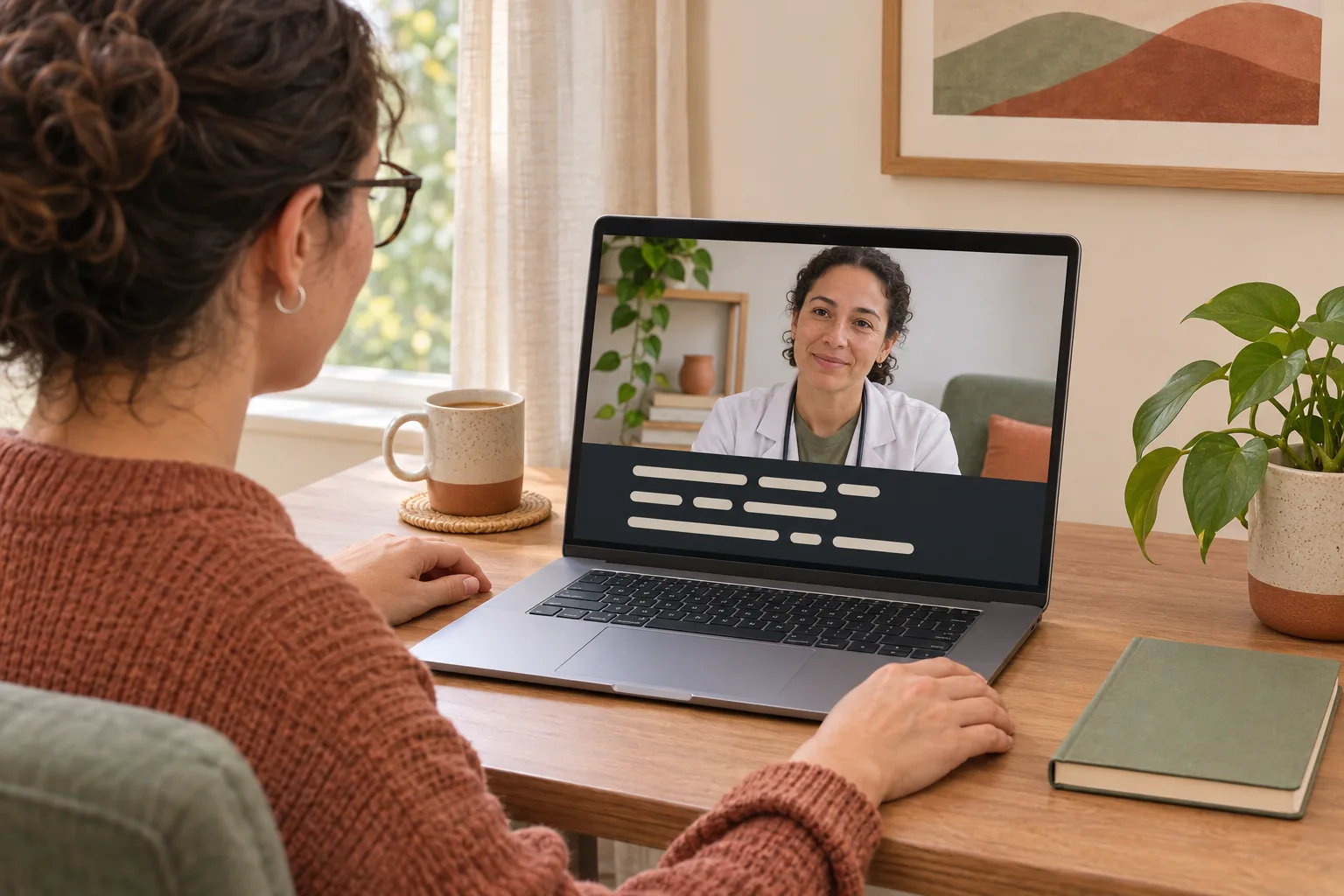
The therapist’s video is clear, but you keep losing words. You may need captions because you are deaf or hard of hearing, because written information is easier to process, or for another communication reason. The useful question is how you can follow and contribute to the actual conversation, not whether you can manage by guessing.
This guide helps adults ask a US therapy provider about caption access. The US guidance cited here does not establish how another country’s law applies. It also cannot decide an individual entitlement, guarantee a particular platform feature or determine whether video therapy is suitable for your care.
Ask for access to the conversation as it happens
HHS and DOJ telehealth guidance specifically describes a mental-health provider potentially needing a platform that supports effective real-time captioning for a patient who is hard of hearing. It says the provider may not require that patient to bring their own real-time captioner. This is an access responsibility, rather than merely a suggestion to turn up the volume.
Start with a functional request: “I need to read the conversation while we speak so I can participate. Who can confirm a caption arrangement for my appointment?” If the booking team cannot answer, ask which person handles communication access. Avoid sending a detailed therapy history to a general technical inbox.
Our sensory-friendly appointment guide covers broader access planning. Here, the task is narrower: arranging a usable live text channel, checking its limits and knowing what happens if it fails. A message acknowledging the request is not yet confirmation that the captions will be available.
Distinguish captions, interpretation and a later summary
Captions present speech as text during the conversation. W3C’s caption guidance distinguishes same-language captions from translation into another language and describes professional real-time captioning, including CART services. The name CART contains the word “translation,” but it refers here to rendering speech as text, not necessarily changing the spoken language.
If you need a sign language interpreter or spoken-language interpretation, say that explicitly. Do not assume a caption setting provides either service. Equally, a summary after the appointment does not let you ask a question at the moment you missed an explanation.
DOJ’s effective-communication guidance lists real-time captioning among possible aids and services. The appropriate arrangement depends on the person’s usual communication methods and the conversation’s nature, length, complexity and context. A short booking exchange and a complex therapy discussion may require different support.
Ask what is actually proposed: automatic speech recognition, a professional captioner or another arrangement. You can explain what has and has not worked for you without having to endorse a particular vendor. If the proposal does not address your barrier, describe the unresolved problem and ask who can review it with you.
Confirm accuracy and a way to interrupt errors
W3C cautions that automatic captions can change meaning when words are wrong or missing. An enabled caption button does not establish that the text is accurate enough for a care discussion. The useful question is whether you can understand, respond and correct misunderstandings in that setting.
Ask how to signal that a sentence needs repeating. You might agree on a raised hand, a short chat message or another accessible cue. The therapist can then pause, restate the point and check it with you instead of continuing while you try to reconstruct several missed sentences.
For example, if the text displays “I do want to discuss that” when you understood “I don’t,” stop and clarify the meaning. This invented example illustrates why a small error matters; it is not evidence about a specific platform. Do not use a guessed caption to decide what a clinician meant about treatment or safety.
[!CALLOUT:note] A transcript later cannot repair every missed moment Ask for clarification during the appointment and confirm important next steps directly with the clinician. This guide does not recommend relying on unverified automatic text as a clinical instruction or making treatment changes from it.
Ask who receives the audio and what is retained
Before a sensitive conversation, ask how captioning is delivered. Does another person join? Does a service process the audio? Who can see the text, and is a recording or transcript created, stored or available to download? Ask the provider to explain its actual arrangement and consent process in language you understand.
Do not assume live text automatically means the session is recorded. Do not assume the opposite either. A particular tool’s behavior, settings and the provider’s practices need confirmation. “Captions enabled” leaves those questions unanswered.
Keep this separate from other people involved in care. For instance, our guide to therapy with a trainee examines supervision and observation consent. A supervisor reviewing care and a captioner providing communication access have different roles, even if both require a clear explanation of who receives information.
If privacy concerns make an option difficult for you, tell the provider and ask what other effective arrangement can be discussed. Do not upload a therapy recording to an unrelated captioning site or add an unapproved recording bot as a workaround. A convenient feature is not enough information to decide that use is appropriate.
Test the arrangement without rehearsing your therapy
Ask whether a short setup check is available before the appointment and who can help with it. Use ordinary speech, such as discussing the weather or confirming a meeting time. There is no need to disclose clinical material to see whether the text is visible and whether both people know how to pause.
Use this checklist to turn a general promise into practical questions:
- Which link and device should I use, and how do I activate or view the agreed captions?
- Can I read the text while still seeing the therapist, and can its size or placement be adjusted?
- Who arranges and admits a professional captioner if one is part of the plan?
- How will I signal an error, delay or missing text, and who will respond?
- What accessible contact and backup are agreed if the arrangement fails?
A test can reveal a problem; it does not guarantee every later sentence will be captured correctly. Note unresolved points and ask the service what it will do next. If the check is not available, ask how access will be verified at the start of the visit rather than assuming that it has already been tested.
Keep a usable backup and confirm the care plan
A phone call is not a usable backup for everyone who needs captions. Ask the provider to agree on a response that fits your communication needs and clinical circumstances. That might involve restoring the caption service or discussing another accessible appointment arrangement; availability and suitability need actual confirmation.
If captions stop, use the agreed signal and tell the clinician that communication has failed. Ask them to repeat anything you missed before proceeding. Do not feel obliged to pretend you understood to protect the appointment’s pace.
Before ending, check the main next steps and how to ask a follow-up question. If an access problem remains, ask for the service’s accessibility or patient-relations route. You can seek an explanation or review without turning the request into a claim that this article has already determined a legal violation.
Urgent care should not wait for an ideal technical setup. Tell the service about both the urgency and the access need, and use appropriate local urgent or emergency support when needed. Get Help offers further support routes. An unanswered routine caption request is not an emergency response system.
Common questions
Are automatic captions always enough for video therapy?
No single feature answers that for every person and conversation. Ask about the actual arrangement, accuracy, your communication needs and how errors will be corrected. Explain if the proposed text does not let you participate effectively.
Does using captions mean my session is recorded?
Not necessarily. Ask the provider whether its specific setup creates or retains audio, video or text, who can access it and what consent applies. Do not infer the answer from the presence of a caption button.
Should I bring a relative to type what the therapist says?
Do not assume that is required or an adequate replacement. Ask the provider to arrange effective access; HHS guidance says it may not require the patient in its captioning example to bring their own real-time captioner. A support person’s role should reflect your wishes and the actual care arrangement.
Behind this guide
Sources & further reading
Written by Vitaly ChopikMinds Vary · Editorial standards