
ADHD Cleaning Planner: A Flexible Weekly Checklist
Build a flexible ADHD cleaning planner with a weekly checklist, a small daily minimum, realistic stopping points, and a way to restart after missed days.
 AuthorVitaly Chopik
·8 min read

In brief
What to take away
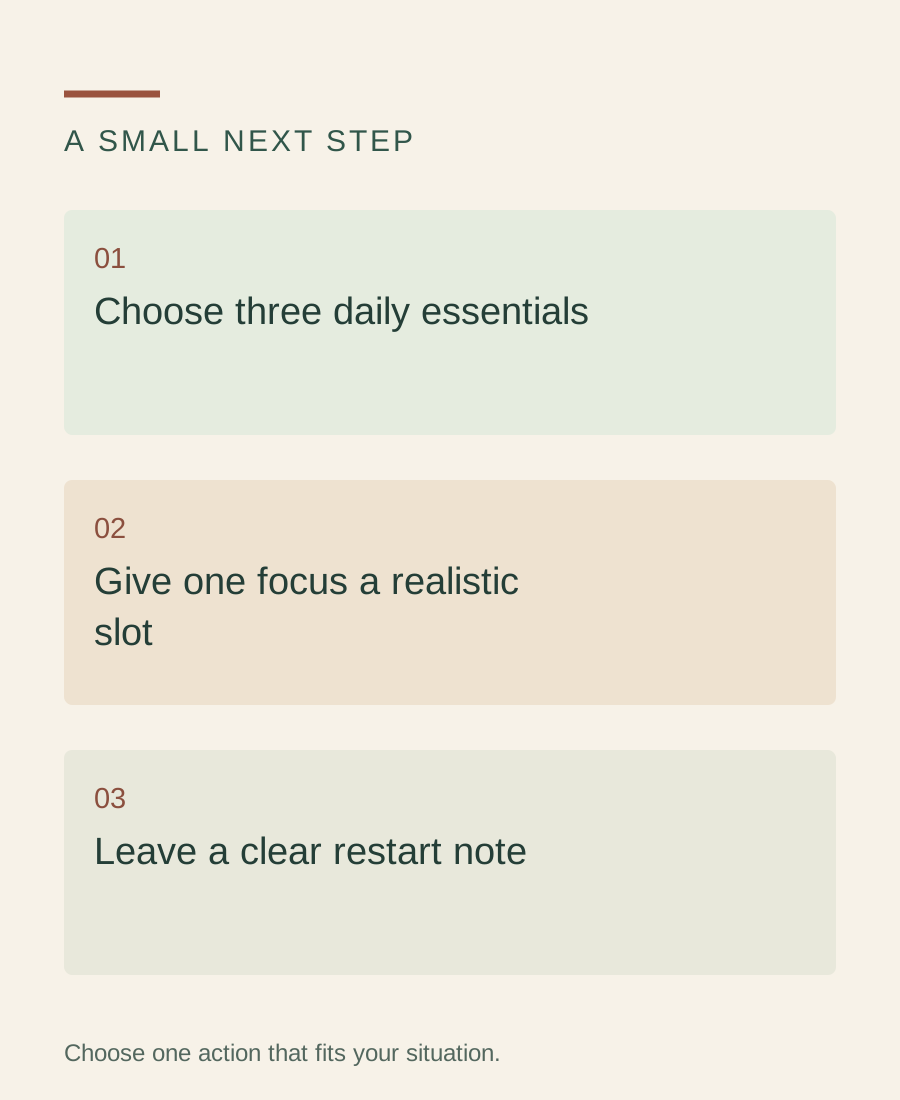
- Choose three daily essentials.
- Give one focus a realistic slot.
- Leave a clear restart note.
A cleaning plan you can return to
An ADHD cleaning planner is most useful when it answers three questions: what needs attention, what counts as enough today, and where do I resume after a missed day? A page full of unchecked boxes answers none of them. It can turn a practical job into a running record of disappointment.
Start with a small daily minimum and a rotating weekly focus. Keep missed jobs available for the next suitable slot rather than doubling tomorrow’s workload. This guide includes a sample week, a reusable planning sheet, and ways to adapt it for shared housing, disability, irregular work, or a home that already feels overwhelming.
These are practical organizational suggestions, not a tested treatment program. ADHD can affect planning, attention, and follow-through, but household mess also reflects time, money, health, caring responsibilities, and the space available. A planner should fit those conditions.
Why a detailed checklist can still be hard to use
“Clean the bathroom” hides several decisions: find supplies, choose a surface, move objects, clean, replace them, and put supplies away. A planner can reduce that hidden work by naming an observable action. “Wipe the basin with the appropriate cleaner” is easier to begin than “make the bathroom nice.”
The opposite problem is a checklist so detailed that maintaining it becomes another chore. A useful list contains the actions you forget or find difficult to sequence. It does not need to document every movement. If a box adds no useful information, remove it.
Environmental changes are part of the broader approach described in NICE’s ADHD guidance. The particular household planner below is an example of adapting tasks, rather than a checklist validated by that guideline.
Choose three daily priorities
Choose priorities that keep your home usable. For one person, that may mean a clear route to the door, a safe place to prepare food, and putting food away appropriately. Someone else may need to prioritize pet care, a mobility aid charging area, or the bathroom.
Write your three priorities as actions:
- Clear the walking route between the bed and the door.
- Put away perishable food and gather dishes near the sink.
- Make one preparation area usable for the next meal.
Do not add a fourth action every time you notice something imperfect. The daily minimum loses its purpose if it gradually becomes the full housecleaning routine. Keep a separate “later” list for maintenance and less frequent work.
Choose a cue that already happens, such as finishing dinner or returning from a shift. An exact clock time is useful for some people; a sequence cue is more flexible for others. Test which you actually notice.
Build a flexible weekly rotation
The following is an example, not a standard every home should meet. Swap days, reduce frequency, or replace tasks according to what your household uses and what hygiene requires.
| Day or available slot | Main focus | Smaller version | Stop when |
|---|---|---|---|
| First slot | Bathroom | Clean the toilet and basin | Essential fixtures are usable |
| Second slot | Kitchen surfaces | Clear and clean one food preparation area | There is room for the next meal |
| Third slot | Laundry | Wash one needed load | It is moved to the next safe stage |
| Fourth slot | Floors and routes | Clear the most-used walking route | That route is passable |
| Fifth slot | Bedding or towels | Replace the item most needed | The replacement is ready to use |
| Sixth slot | Paper and objects | Process one small tray | The tray has a defined next step |
| Review slot | Choose next week’s priorities | Check supplies and appointments | One realistic priority is chosen |
This rotation is different from a backlog list. A backlog contains everything you might eventually do. A weekly plan contains the work your actual week can hold. Leave room for interruptions and recovery rather than allocating every available minute.
Make the planner visible at the point of use
Use the simplest format you already access: a sheet on the fridge, a phone note, a whiteboard, or a shared household list. Buying a new system is unnecessary. If your phone pulls you into other activities, paper may remove one source of friction.
Include only these fields:
- Today’s minimum: your three essential actions.
- This week’s focus: one room or category per available slot.
- Next action: a physical step, such as “put a bag beside the bin.”
- Stopping point: an outcome or short work period you can notice.
- Restart note: where to begin next time.
Keep suitable supplies near where they are used when storage is safe. Follow product labels, store chemicals away from children and pets, and do not mix cleaning products. Accessibility may matter more than an attractive storage arrangement.
A worked example for a disrupted week
Imagine a week with a late shift on Tuesday and a difficult appointment on Thursday. Instead of assigning seven equal cleaning sessions, place a bathroom task on Monday, laundry on Wednesday, and a kitchen reset on Saturday. Tuesday and Thursday have only the daily minimum. Friday stays open.
On Wednesday, the laundry does not happen. The plan does not become “laundry plus floors plus bedding” on Friday. You check what is needed most: work clothes for tomorrow. That load becomes the next focus; the less urgent task moves to another week.
This example uses priority and available capacity rather than a perfect streak. For the details of moving clothes through a simpler system, use our laundry guide that does not depend on folding. A weekly planner can point to that system without recreating it.
Troubleshoot the planner rather than judging yourself
If you stop looking at the list, move it closer to the action or shorten it. If you repeatedly underestimate the time, record one actual session, including setup and putting supplies away. Use that observation to reduce the next plan.
If every task feels equally urgent, separate safety and basic use from appearance. A blocked exit needs attention before arranging books by color. If starting remains the main obstacle, try the ADHD paralysis guide and make the first action smaller.
In a shared home, agree who owns each task, what “done” means, and how to handle a missed turn. A planner does not make one person responsible for noticing everything. Paid or informal help, when available and welcome, can be part of the plan rather than evidence that it failed.
Seek practical or professional help if the home has unsafe routes, persistent pests, hazardous waste, or conditions you cannot manage safely. If a recent change in energy, attention, or self-care is substantial, consider a health assessment as well as a new list.
Download the action sheet
Frequently asked questions
Should an ADHD cleaning planner have a task for every day?
Only if that helps you. Some households benefit from a daily rhythm; others need a few flexible slots around shifts or caregiving. Keep essential hygiene and safety needs covered, then schedule the rest according to realistic capacity. An unused blank day is not a problem to solve.
What should I do with unfinished tasks?
Review their actual urgency. Choose the next necessary action and give it an available slot. Avoid automatically adding all missed work to tomorrow. If the same job keeps returning, change its size, equipment, ownership, or frequency rather than repeatedly copying it forward.
Is needing a cleaning planner a sign of ADHD?
No. Many people use cleaning lists, and difficulty with chores has many possible causes. ADHD assessment considers a wider developmental pattern and its impact across settings. You can use a practical support without treating the need for it as diagnostic evidence.
How do I know whether the planner is working?
Look for useful outcomes: easier access to essentials, fewer forgotten steps, less time reconstructing the plan, and a manageable restart after disruption. The number of checked boxes matters less than whether your home is safer and easier to use.
Evidence base
Sources
Continue reading

What Is Executive Dysfunction? An Everyday Guide
Executive dysfunction means difficulty using mental skills that help you plan, start, switch, remember, and finish. See concrete examples and ways to reduce friction.
· 6 min read
An ADHD laundry system for clothes that never get put away
A simple ADHD laundry system for clean clothes that stay in baskets. Plan washing, drying and storage around the step that actually stalls.
· 6 min read
ADHD Paralysis: What Feeling Stuck Can Mean
ADHD paralysis is an informal name for feeling stuck despite wanting to act. Sort choice, start, transition, and overwhelm barriers to find a useful next move.
· 5 min read