
How to Clean a Messy Room With ADHD Without Making It Worse
Clean a messy room with ADHD using a contained sequence, a clear stopping rule, and a checklist that protects the space you need to use tonight.
 AuthorVitaly Chopik
·8 min read

In brief
What to take away
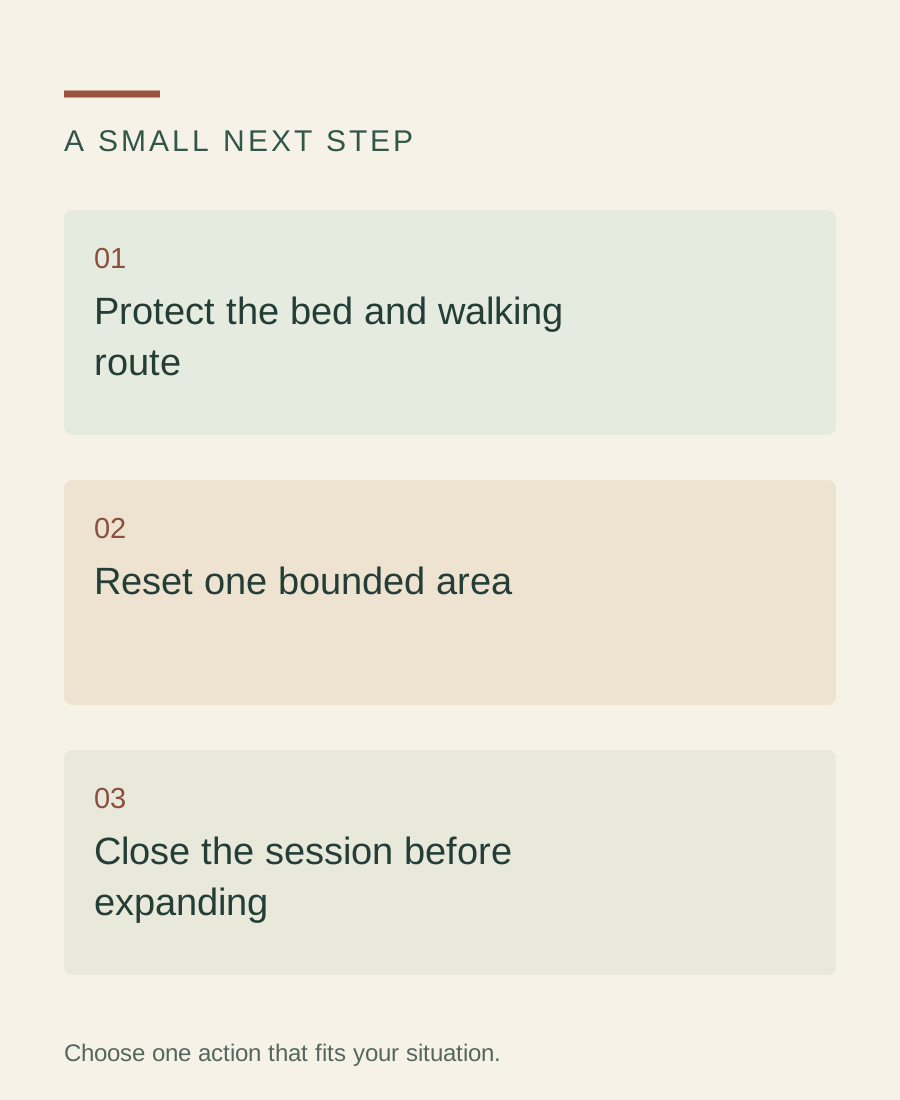
- Protect the bed and walking route.
- Reset one bounded area.
- Close the session before expanding.
Start with the space you need tonight
To clean a messy room with ADHD, choose one useful outcome before touching the mess: a clear route to the bed, a usable desk, or somewhere to sit. Work within a small boundary, remove obvious waste and dishes, then return a limited number of objects to known homes. Stop with the room usable, even if it is unfinished.
The tempting alternative is to empty every drawer and sort everything at once. That can expose more decisions than you have time or energy to finish. This guide uses a contained reset so a short burst of motivation does not leave you without a bed when the energy runs out.
This is a household strategy, not a diagnostic checklist or treatment. You can adapt it whether or not you have ADHD. If a room contains hazards you cannot manage safely, getting help comes before completing the sequence.
Define the boundary and the stopping rule
Choose an area that can remain contained: the chair, one side of the desk, or the path from the doorway. Do not start by moving everything onto the bed unless you have a realistic way to put it away before you need to sleep.
Take a moment to check supplies. You may need a waste bag, a container for dishes, and one small basket for objects that belong elsewhere. Use what you already own. Extra organizing products often add another decision before any cleaning has happened.
Choose an endpoint you can observe. “The desk has space for the laptop and notebook” is clearer than “the room looks better.” A timer can support the endpoint, but a timer alone does not tell you what to do with objects left in your hands.
Make a quick safety pass
Check for anything that changes the task: broken glass, exposed needles or other sharps, spoiled food, pests, unstable stacks, electrical damage, or blocked exits. Keep children and pets away from the working area. Do not pick up unknown sharp objects with bare hands or handle contamination without appropriate help and equipment.
For ordinary clutter, preserve a clear route as you work. Put bags and baskets somewhere they will not become a new trip hazard. If lifting, bending, dust, or cleaning products aggravate a health condition, change the method or ask for assistance.
A photograph can help you notice the boundary, but it is optional. If photographing the room increases shame or creates privacy concerns, write the outcome on paper instead. You do not need to document your home to deserve support.
Use a sequence that avoids new sorting projects
- Remove obvious waste within the boundary. Skip uncertain papers and sentimental objects for now. Put waste directly in the appropriate bag.
- Collect dishes and food items. Take perishables to safe storage promptly. Place ordinary dishes together without starting a full kitchen clean.
- Gather clothing. Separate clearly dirty items from clearly clean items. Use a temporary laundry container rather than opening the entire wardrobe.
- Return things with known homes. If you know exactly where the charger belongs, return it. If you do not, place it in the small review basket.
- Clean the newly available surface. Use the method suitable for the material and product label.
- Close the session. Remove waste, park the review basket safely, and write one next action.
The order is a practical suggestion, not a rule you must follow exactly. If the first necessary outcome is a clear walking route, work on that route first. The useful feature is that each pass asks one type of question.
What to do with the objects that have no home
Mixed objects can derail a reset because each one opens a separate question: keep it, repair it, return it, file it, or find storage? Give those decisions a small, visible holding space. Label it with an action and a review date you can realistically keep.
| Object | During the reset | Follow-up action |
|---|---|---|
| A bill you have not opened | Put it in a visible action tray | Check its deadline during the next admin slot |
| A cable with an unknown purpose | Place it in the review basket | Check what it connects to before discarding |
| A borrowed book | Put it with outgoing items | Contact the owner or choose a return date |
| A sentimental item | Set it aside safely | Decide when you have capacity for that decision |
The basket needs a limit. If it fills, choose a small review session before collecting more. If you want to process mixed objects rather than reset the whole room, the separate doom-pile approach is the more suitable task for another day.
An example: a bedroom before bedtime
Suppose you have a short window before sleep. The bed holds clothing, the floor has bags, and the desk is covered in papers. Choose “reach the bed safely and sleep in it” as the outcome. The desk can wait unless it contains an urgent safety or time-sensitive issue.
Move obvious waste to a bag. Put dirty clothes into the laundry container. Put clean clothes into one temporary clean-clothes basket rather than beginning a folding project. Move the bags out of the walking route to a stable location. Check that the door opens and the path remains clear.
At the end, the desk is still untidy. That does not cancel the improvement. Write “open the top three envelopes at the desk” as a possible next session. You have completed a bedroom access reset, which is a different job from organizing every possession.
When motivation disappears halfway through
Pause new decisions and close the current work. Put the object in your hand into its destination, remove the waste bag if feasible, and secure supplies. Leave a note that names the next action, not the whole remaining project.
If you regularly spend the entire session carrying objects between rooms, collect them first and make one delivery trip. If a basket becomes another hidden pile, make it smaller and keep the label visible. If a helper is involved, agree on the boundary and ask them to avoid expanding the project without checking.
For difficulties with starting, our task initiation guide offers a way to make the first action more concrete. If company helps you remain with the task, consider a consensual body-doubling arrangement. You should still control what is touched, kept, and discarded.
Your room-reset checklist
- Name one useful outcome.
- Protect the bed, door, and walking route.
- Gather a bag and one small review container.
- Work through one category at a time.
- Avoid opening drawers or cupboards outside the boundary.
- Close the session and write a specific restart note.
If the mess repeatedly becomes hazardous, or daily living is becoming harder despite support, ask for practical assistance and consider discussing the change with a clinician. The ADHD overview explains why a broader assessment matters.
Download the action sheet
Frequently asked questions
Should I clean the whole room in one session?
Only if it is realistically manageable and you can stop safely. A smaller completed area is often more useful than opening the whole room and leaving essential spaces unavailable. Choose the scope before starting and expand it only after closing the first area.
What if I cannot decide whether something is rubbish?
Do not force a decision during the waste pass. Put the uncertain object in a small review area, especially if it may contain personal information, money, or a deadline. The purpose of the pass is to remove obvious waste without turning every object into a debate.
Can I listen to music while cleaning?
Yes, if it helps and does not interfere with safety or the task. Choose the audio before beginning so selecting it does not consume the session. If following the music becomes distracting, try quieter sound or no audio. There is no required ADHD soundtrack.
What if someone else thinks the room is still too messy?
Discuss a concrete shared standard when you have capacity: clear routes, usable furniture, hygiene, and ownership of common areas. A staged reset can be progress toward that standard. Humiliation and unsolicited disposal of belongings are unlikely to make collaboration easier.
Evidence base
Sources
Continue reading

What Is Executive Dysfunction? An Everyday Guide
Executive dysfunction means difficulty using mental skills that help you plan, start, switch, remember, and finish. See concrete examples and ways to reduce friction.
· 6 min read
An ADHD laundry system for clothes that never get put away
A simple ADHD laundry system for clean clothes that stay in baskets. Plan washing, drying and storage around the step that actually stalls.
· 6 min read
ADHD Paralysis: What Feeling Stuck Can Mean
ADHD paralysis is an informal name for feeling stuck despite wanting to act. Sort choice, start, transition, and overwhelm barriers to find a useful next move.
· 5 min read