
Sensory Overload in Adults: When Ordinary Input Becomes Too Much
Sensory overload can build when sound, light, movement, touch, smell, temperature, and social demands exceed available capacity.

In brief
What to take away
- Sensory overload describes a state in which incoming sensory and environmental demands exceed the capacity available in that moment.
- The environment is part of the event, and tolerance can change with sleep, pain, illness, stress, predictability, and cumulative load.
- The first response is usually to reduce input and demands, preserve an exit, and allow recovery before asking for explanation or decisions.
The ordinary moment behind the search
The restaurant was manageable when you arrived. Then the music rose, a blender started, chairs scraped, someone touched your shoulder, and three conversations required answers. Nothing is individually extreme, yet the room suddenly feels physically close. Words become harder to find, light seems sharper, and staying polite consumes the remaining capacity. Sensory overload is often described as an overreaction to one sound or texture. In practice, it may be cumulative, multi-sensory, and shaped by everything the nervous system was already carrying before the visible moment.
Searches for sensory overload in adults often begin because a familiar situation has become difficult to explain. A short label can provide relief: at last, there may be words for what is happening. But the most useful answer is rarely a one-line verdict. It needs to separate a descriptive phrase from a diagnosis, make room for physical and situational factors, and lead toward a proportionate next step rather than a new source of shame.
This article is educational. It cannot identify a condition, reconstruct someone’s history, assess immediate danger, or choose treatment for an individual reader. It can help you organize observations and decide what information would be useful in a conversation with qualified support.
What the term is trying to describe
Sensory overload is an everyday descriptive phrase rather than one diagnosis. It refers to a state in which sensory and environmental input becomes more than a person can comfortably process or respond to. Sound, light, visual movement, touch, smell, taste, temperature, pain, balance, body sensations, social interpretation, and rapid demands can combine. Autistic people commonly report sensory differences, but overload can also occur with migraine, traumatic stress, anxiety, illness, brain injury, sleep loss, attention difficulties, or other conditions. The relevant experience is real even when the cause is not yet clear.
A term earns its place when it improves accuracy, access, or communication. It becomes less helpful when it turns into a character judgment, a complete identity imposed from outside, or proof that one explanation accounts for every difficulty. Sleep, pain, physical health, medication, substances, stress, safety, workload, sensory conditions, relationships, culture, and available support can all change how a person functions.
The practical question is therefore not only “Does this word fit?” It is also: what changed, where does it happen, what does it cost, what else could contribute, and what would make the next situation safer or more workable?
What people may notice in daily life
The pattern may include combinations such as:
- Speech becomes slower, shorter, repetitive, or temporarily unavailable as input continues.
- A person needs to leave, cover ears or eyes, stop being touched, pace, rock, or become very still.
- Decision-making and comprehension decline, especially when several people ask questions at once.
- Irritability, tears, panic-like sensations, shutdown, or abrupt withdrawal appear after cumulative input.
- Recovery requires more time than observers expect, sometimes extending beyond the end of the event.
No item in this list is a test. A single relatable experience can occur for many reasons, and people with the same diagnosis or identity do not share one profile. Pay more attention to duration, frequency, change from your own baseline, impact across settings, and the conditions that increase or reduce the difficulty.
Hidden effort matters too. Someone can appear productive, calm, sociable, organized, or independent while spending substantial energy to create that appearance. Functioning and distress are not opposites. The visible result may conceal preparation, recovery time, missed needs, or a narrowing life.
The distinction that keeps the answer accurate
Overload is not the same as disliking a stimulus, and it is not automatically a panic attack, meltdown, migraine, or medical problem—although those can overlap. If an episode becomes outwardly intense or unusually withdrawn, the shutdown and meltdown comparison explains those flexible terms and immediate support. It is also not evidence that a person lacks maturity or social commitment. The same adult may tolerate a setting on one day and not another because capacity changes with pain, sleep, hunger, health, hormonal shifts, uncertainty, masking, and earlier demands. That variability does not make the need imaginary. It means support should respond to the current load rather than a fixed expectation based on yesterday.
Accuracy also means leaving room for uncertainty. An online article cannot rule out a physical condition, a medication effect, sleep loss, substance-related effects, grief, current danger, or another mental-health or neurodevelopmental explanation. New, severe, rapidly changing, or physically concerning symptoms deserve appropriate medical attention rather than automatic attribution to a familiar label.
For the specific setting of a clinic or consultation, the adult health-appointment access map offers advance questions, service-confirmation checks and examples of communication requests. It does not replace urgent care or guarantee a particular arrangement.
Five practical ways to create more choice
Start with the actual barrier rather than a universal routine. These options are experiments, not obligations:
-
Change the fastest adjustable input. Move away from a speaker, lower lighting, step outside, stop touch, reduce visual motion, or use ear protection if it is safe to do so. One meaningful reduction can create enough capacity for the next choice.
-
Use fewer words. Offer simple options such as “quiet room or outside?” and allow time for response. Avoid requiring a detailed explanation while speech and decision-making are impaired.
-
Preserve a low-explanation exit. Agree in advance that someone can leave a meeting, event, classroom, or social setting without persuading others that the threshold is legitimate.
-
Plan the recovery phase. After input drops, the person may need quiet, familiar movement, pressure, food, hydration, darkness, solitude, or sleep. Recovery is not the moment for conflict analysis.
-
Adjust the repeatable environment. For recurring settings, consider seating, lighting, remote participation, agenda clarity, scent policies, break access, flexible clothing, and predictable transitions.
Try one or two changes at a time. A strategy that does not help is information about fit, timing, access, or cause; it is not evidence of laziness. Stop any exercise that increases pain, panic, compulsive monitoring, conflict, dissociation, or risk, and choose a safer alternative.
Keep a small observation record
A brief record can make the pattern easier to communicate without turning daily life into constant symptom tracking. Use ordinary language and keep the record proportionate.
| Moment | Question | Useful detail |
|---|---|---|
| Load | Which inputs accumulated? | Sound, light, movement, touch, smell, temperature, pain, social demands, and uncertainty. |
| Threshold | What changed first? | Speech, comprehension, movement, irritability, tears, pain, urge to leave, or stillness. |
| Recovery | What restored access? | Distance, darkness, pressure, movement, food, water, solitude, familiarity, or sleep. |
Dates, examples, and impact are usually more useful than trying to sound clinical. Keep notes private. Do not collect another person’s sensitive information without consent, and do not continue tracking if the process itself fuels anxiety, reassurance seeking, or compulsive checking.
How to talk about what is happening
A practical sentence might be, “When several people speak over background music, I stop processing language. I need a quieter seat and permission to step out before I lose speech.” A supporter can ask about preferred responses when the person is calm: whether touch helps or harms, which communication method works, how to signal an exit, and when to check in. Do not assume that a person who cannot speak cannot understand what is being said around them.
A useful opening sentence names function: “This has been happening for about this long, in these settings, and it changes these parts of daily life.” Add two or three recent examples. You do not need a polished theory before asking a clinician, workplace contact, educator, or trusted person what kind of support is available.
For a practical request, describe the barrier and one proposed change. Written instructions, clearer priorities, more notice before transitions, a quieter setting, a short pause, flexible communication, or help navigating care may be more useful than debating the perfect label. In employment or education, ask what documentation is actually required and how privacy is handled.
When qualified or urgent support matters
Recurring overload that limits daily life can be discussed with an appropriately qualified clinician or occupational therapist, especially when autism, migraine, hearing or vision changes, pain, trauma, medication, or another health factor may be involved. Sudden sensory change, severe headache, weakness, confusion, fainting, neurological symptoms, or other acute physical concerns require medical assessment. Environmental support can be appropriate while the cause is still being evaluated.
Consider professional support when the pattern is persistent, worsening, recurring, or affecting work, study, relationships, finances, sleep, eating, medical care, driving, or safety. A qualified clinician can consider mental-health, neurodevelopmental, physical, medication, substance, and situational factors together. You can bring notes about onset, frequency, context, body sensations, previous episodes, and what has already helped.
In the United States, call or text 988 for suicidal or mental-health crisis support. Call 911 for immediate life-threatening danger. Outside the United States, use the emergency or crisis services for your location. A directory, crisis line, primary-care office, community clinic, specialist, and trusted person may each play a different role; one doorway does not have to provide every kind of help.
A more workable conclusion
Sensory overload is not a failure to tolerate ordinary life. It is a signal that the combination of input and demand has exceeded current processing capacity. Respond by reducing load, preserving communication and exit options, and treating recovery as part of access. Later, use the pattern to redesign predictable settings so the person does not have to reach a crisis threshold before the environment changes.
You do not need perfect certainty to reduce one source of friction, make the environment kinder, ask a clearer question, or contact qualified support. The responsible next step is often not a final label. It is a more accurate description, a preserved route to safety, and one action small enough to use in real life.
Evidence base
Sources
Continue reading

The Restaurant Was Fine—Until It Wasn’t
Sensory load can build quietly and become overwhelming all at once. Here is a kinder way to notice the whole environment and plan for what helps.
· 5 min read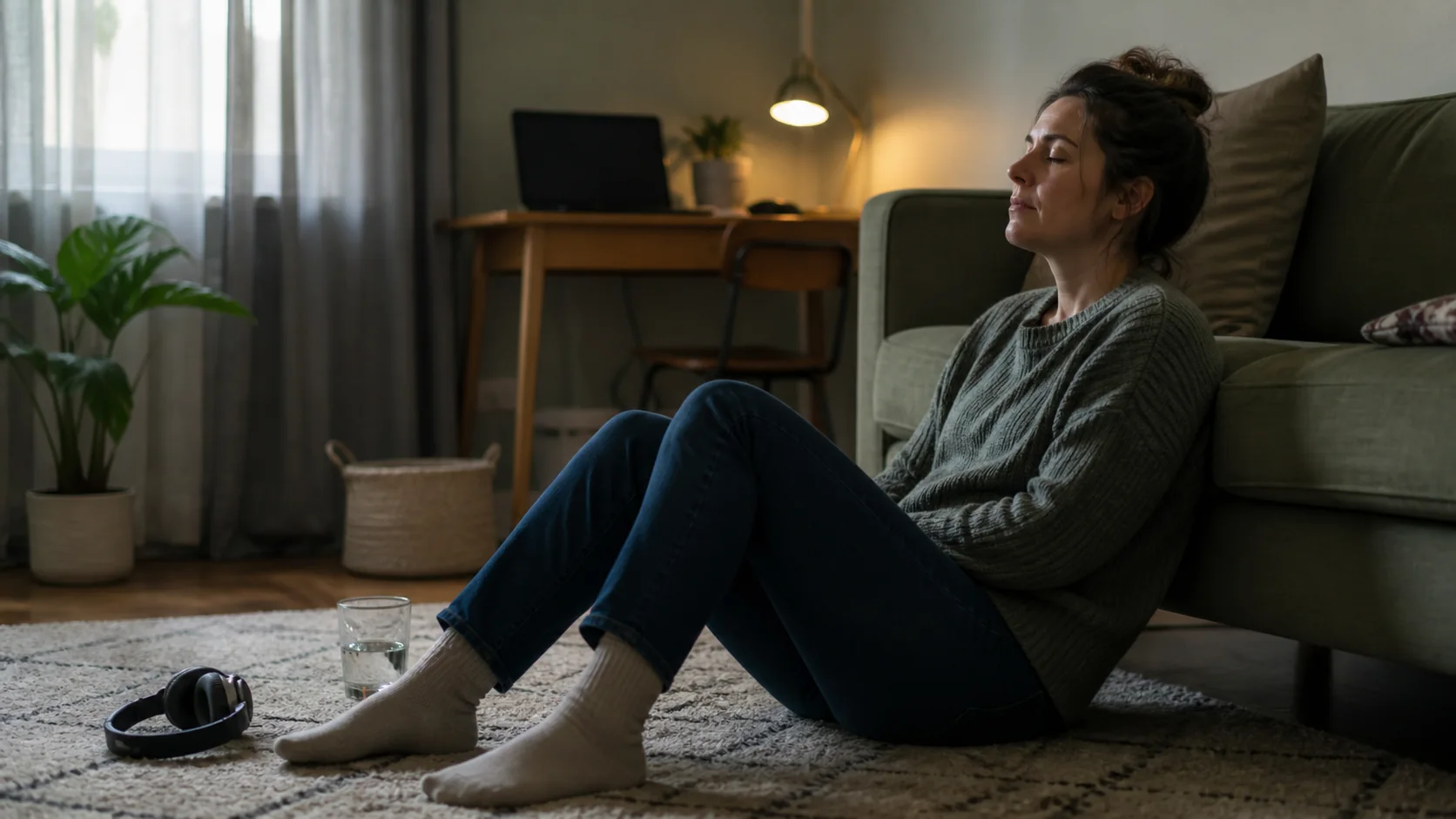
When Rest Isn’t Restoring You: Understanding Autistic Burnout
Sometimes a weekend off does not restore speech, energy, or everyday capacity. Autistic burnout offers one careful framework for understanding that deeper depletion.
· 7 min read
Listening Does Not Always Look Like Eye Contact
Looking away can make it easier to process language, organise a response, or stay in a conversation. Attention deserves better evidence than a gaze test.
· 5 min read