A Minds Vary guide Anxiety & OCD
White or Pink Noise for Sleep: Should You Use It?
Considering white or pink noise for sleep? Weigh uncertain evidence, identify the noise you want to mask, and protect hearing, alarms, and comfort.
 Written byVitaly Chopik
7 min read
Educational information for everyday wellbeing. Clinical review is recommended; this guide has not been clinically reviewed. Our review standards
In this guide
- Name the sound problem before choosing another sound
- Understand what white and pink noise labels can tell you
- Read the evidence without turning it into a universal rule
- Protect hearing and the signals you need to hear
- Make an ordinary, reversible comparison
- Know when the question is bigger than a sound machine
- Common questions
- Sources & further reading
The starting point
A few things to keep in mind
Identify the actual noise barrier before adding continuous sound to a bedroom.
Research does not establish that every white- or pink-noise routine improves sleep; the sound and study conditions matter.
Keep sound optional, preserve alarms and household communication, and ask for care when sleep problems persist.
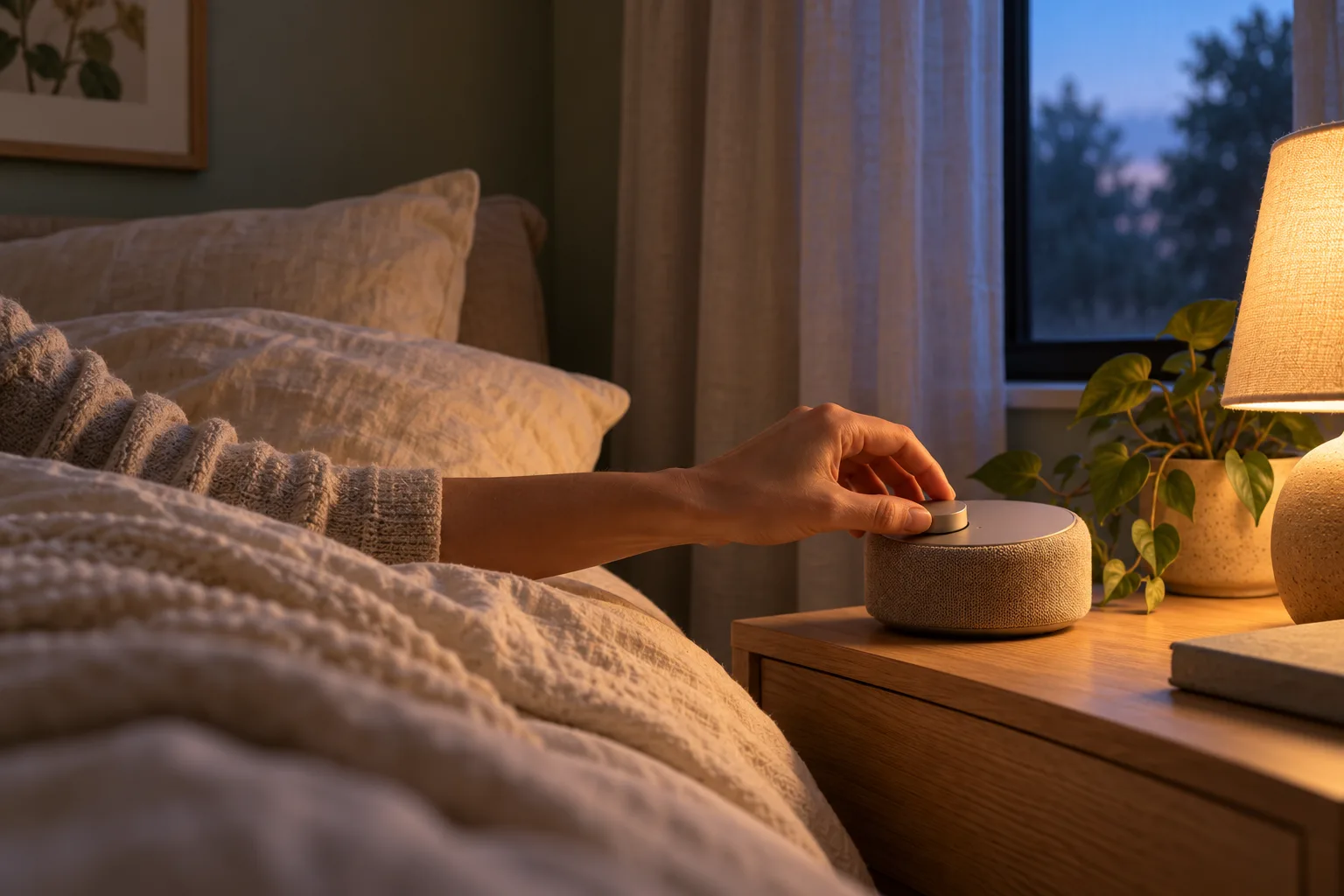
White or pink noise is an optional addition to a bedroom, not a requirement for good sleep. Before turning on a sound machine, ask what you want it to change. Masking an unpredictable hallway sound is a different goal from treating a persistent sleep problem.
The research does not justify promising that one “color” of sound will make every adult sleep better. A quieter setup, a different response to an avoidable noise, or choosing no added sound may be reasonable. This guide concerns adults; it does not give sound-machine instructions for babies or children.
Name the sound problem before choosing another sound
Try describing the barrier in ordinary terms: voices through a shared wall, a door that slams, street traffic, or a fan that changes pitch. Then ask whether the source can be changed safely. A household agreement about a door or a different device position may address the particular problem more directly than another layer of audio.
You may have little control over your housing or schedule. Naming that limit helps keep the decision realistic. You should not have to buy several products to prove you are trying to sleep. Start with what is feasible, and separate an environmental irritation from a claim that you need a special sleep aid.
If the room is already reasonably quiet but you remain awake, adding sound may not answer the main question. That does not identify the cause of the sleep difficulty; it simply gives you a reason to look beyond a product setting.
Understand what white and pink noise labels can tell you
White and pink noise are forms of broadband sound, with energy distributed differently across frequencies. They can sound different, and a recording may also contain changes, loops, or other effects. A calming name on an app is not a clinical description of what will happen to your sleep.
The practical distinction is between what you find tolerable while awake and what has been shown to improve sleep under particular conditions. Enjoying a sound as you get ready for bed does not prove that leaving it on through the night improves sleep. Finding it irritating is also enough reason not to use it; you do not need to learn to like it.
Check what a device actually plays and whether you can control or stop it without difficulty. You do not need to become an audio engineer. The useful questions are whether the sound is predictable, whether its controls are accessible, and whether it solves the barrier you named.
Read the evidence without turning it into a universal rule
A systematic review published in 2022 found no strong evidence supporting auditory stimulation for adult sleep. Studies differed in participants, sound types, and methods. That uncertainty should not be simplified into either “proven sleep treatment” or “all sound is harmful.”
A 2026 Penn Medicine sleep-laboratory report described 25 healthy adults studied across seven nights. Continuous pink noise under the tested conditions reduced REM sleep, and combining it with aircraft noise also disrupted sleep. The participants were not an everyday sample of all people using every kind of home sound aid.
The appropriate conclusion is limited: a pleasant or popular sound cannot automatically be assumed to improve sleep, and the exposure conditions matter. The study does not establish your personal response, a universal safe overnight setting, or a rule about every recording. This guide therefore offers a decision process rather than a sound prescription.
Protect hearing and the signals you need to hear
CDC hearing guidance explains that sound exposure depends on both loudness and duration. It recommends reducing volume and taking breaks from noise. That general advice does not provide a guaranteed safe overnight volume for a sleep device.
Avoid responding to an intrusive outside sound by continually turning a speaker up. Check whether you can still hear the alarms, calls, or care-related signals that matter in your home. Another person may need to hear you, or may find the sound you chose uncomfortable. Discuss those needs before bedtime rather than assuming that steady audio is neutral for everyone.
This article does not recommend sleeping in headphones, using a numerical volume target, or buying earplugs. If hearing needs, existing symptoms, or household safety make an option uncertain, ask an appropriate professional. New hearing concerns deserve assessment rather than repeated experiments with a louder or different recording.
[!CALLOUT:note] No added sound is a valid choice You can turn a sound machine off if it is uncomfortable, distracting, or unhelpful. A marketed sleep aid is not a task you must keep practising until it works.
Make an ordinary, reversible comparison
If you choose to explore an optional sound, keep the aim small: whether it makes a particular noise less intrusive while remaining comfortable and compatible with safety needs. You are not running a clinical trial or trying to control every factor in a night’s sleep.
A few questions can keep the comparison useful:
- What specific noise am I trying to make less noticeable?
- Is the added sound comfortable without increasing the volume repeatedly?
- Can I still hear necessary signals, and is the arrangement acceptable to anyone sharing the room?
- Does the device make the evening simpler, or does adjusting it become another prolonged task?
- Would switching it off or addressing the original noise be a more useful next step?
Avoid checking a sleep tracker all night to decide whether the sound is “working.” In the morning, an ordinary observation about comfort, awakenings, or daytime sleepiness may be enough. You do not need to calculate sleep stages from an app or compare your result with someone else’s screenshot.
Know when the question is bigger than a sound machine
The NHS insomnia guidance advises seeking care when sleep difficulties persist, habit changes have not helped, or everyday coping is affected. Do not keep buying or adjusting audio products instead of discussing that wider pattern. Ask for help sooner when symptoms or daytime safety concern you; a calendar threshold is not a reason to delay necessary care.
Mention loud snoring, waking with breathing difficulty, significant pain, medicines, and daytime effects when seeking an assessment. Do not change prescribed treatment because an audio routine seems easier to manage. If you feel too sleepy to drive safely, avoid driving and address the immediate safety issue.
Our sleep-diary guide explains how brief notes can help without tracking every minute. Readers who recognize a tired-but-wired pattern can also explore ADHD and sleep, while remembering that sleep difficulty does not establish ADHD. A product choice and a health assessment can be separate decisions.
Common questions
Is pink noise better than white noise for everyone?
No such general conclusion is established here. Research methods and sound exposures differ. Choose around an actual barrier, comfort, and safety rather than assuming a label identifies the best option.
Should I leave sound playing all night if it helps me settle?
Helping you settle while awake does not establish the effects of overnight exposure. There is no universal setting in this guide. Consider whether continued sound is necessary and discuss individual concerns with an appropriate professional.
Does turning the machine off mean I have failed at improving sleep?
No. Removing an unhelpful addition is a useful decision. Persistent sleep problems deserve a broader assessment rather than a requirement to make one particular aid work.
Behind this guide
Sources & further reading
Written by Vitaly ChopikMinds Vary · Editorial standards