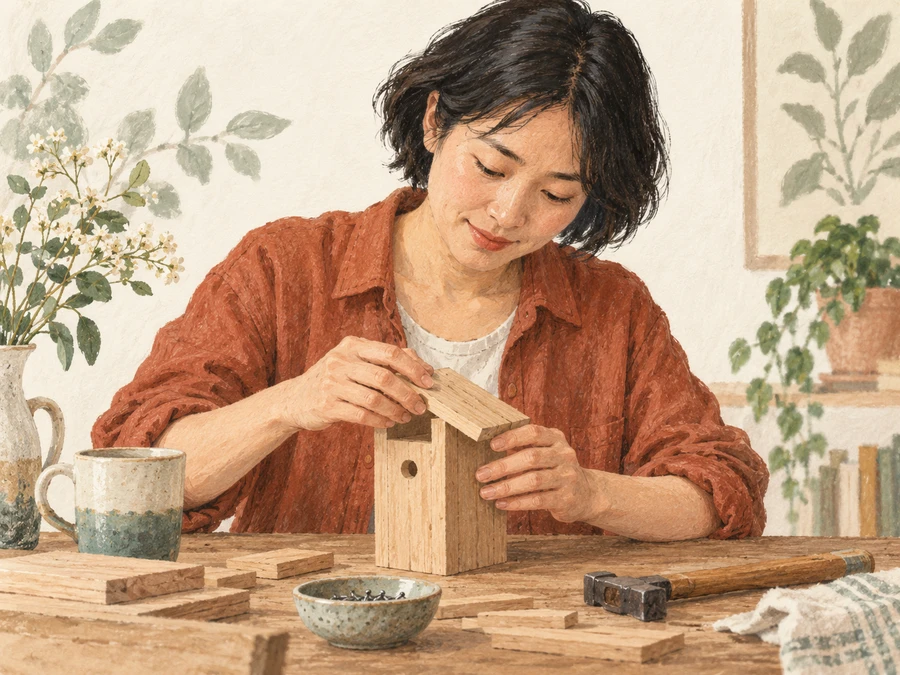

A child’s expression deserves curiosity, even when it differs from the experience you hoped to share.
Making room for the child’s perception
You may enjoy noticing the world alongside a child: the sound of rain, the shape of a leaf, or the feel of a material used in a craft. Imagine offering paints and discovering that the child wants to mix every color rather than make a recognizable picture. Ask what they are exploring instead of directing them toward your preferred result. Choose materials and supervision appropriate to their age. The purpose can be experience, play, or curiosity rather than a finished product. A child learns that their perception matters when the adult is interested in what they notice, not only in whether they produce something pleasing.
Providing clear ordinary boundaries
An open-ended style can be enjoyable, but children need dependable limits around sleep, transitions, safety, and shared responsibilities. Explain those limits in concrete language and offer genuine choices inside them. A child might choose pajamas or a bedtime story while the bedtime itself remains consistent. Give notice before ending an absorbing activity and help younger children make the transition. Flexibility should respond to real needs rather than leaving expectations uncertain from day to day. Clear routines can create more freedom for exploration because the child does not have to guess what will happen next or discover a limit only after crossing it.
Supporting feelings without erasing guidance
Suppose a child becomes upset when a sibling touches a project they made. Acknowledge the disappointment and help them state the boundary: “Please ask before using that.” At the same time, keep limits around how people treat one another. Feeling angry does not make hitting or humiliation acceptable. Offer age-appropriate help with finding words and making a repair. Avoid labeling the child as sensitive, artistic, or a particular type. Those labels can narrow how they are allowed to develop. Their current response is a situation to understand, not a permanent identity. Ordinary support includes both respect for feelings and guidance about behavior.
Letting interests belong to the child
You may hope to share activities that carry personal meaning, such as music, gardening, or making things by hand. Invite participation without making enjoyment a requirement for closeness. A child can decline a hobby and still value time with you. Ask what they would like to show or teach you, even if it is unfamiliar. Support manageable responsibilities so expression does not depend on someone else doing all the preparation and cleanup. If you react with disappointment, keep responsibility for that feeling with the adult. A caring relationship gives the child room to develop preferences of their own while knowing that attention and affection remain dependable.
Make it your own
A moment to reflect
- Am I curious about the child’s experience or attached to a particular result?
- Which predictable routine would make exploration easier for our family?
Keep what fits your experience. Leave room for what doesn’t.
About this guide & sources
This is an independent guide to a personality preference framework. The everyday situations, questions, and suggestions are original illustrations for reflection, not findings about every person with a particular code. A type does not establish a diagnosis, ability, or compatibility.
The letter meanings follow the Myers & Briggs Foundation’s explanation of preferences. Scientific support for dividing people into distinct types is debated; McCrae and Costa’s 1989 study found dimensional differences rather than clear-cut categories in its sample.
For the framework’s approach to differences between people, see the Foundation’s relationships overview. The scenarios on this page are not compatibility predictions.
Read more about MBTI and the Big Five →